

Quick question. Where do your spare batteries live right now? If you said “that one drawer in the kitchen with the takeout menus, dead pens, and a random Allen wrench,” congratulations, you are like almost everyone in America. You are also making a mistake that battery makers and fire departments actively warn against. I always figured a battery was a battery. Buy it, toss it in a drawer, grab it when the remote dies. Turns out the way most of us store them is a little chaotic, occasionally expensive, and in rare cases genuinely dangerous.
None of this is about being scared of your TV remote. It is about a handful of small habits that quietly wreck batteries and, once in a while, start a fire in a trash can. Here are the surprising ones worth knowing.
The junk drawer is the worst place, and here’s why
Tossing loose batteries into a drawer feels harmless. The problem is what else lives in there. Coins, keys, paper clips, other batteries. When the positive and negative ends of a battery touch metal, they can complete a circuit. That circuit can make the battery heat up, leak, or in rare cases actually catch fire. This is not some far-fetched lab scenario either. According to the loose battery problem, that random pile of metal rubbing together is exactly the setup that causes trouble.
The fix costs nothing. Keep batteries in their original packaging until you need them, or grab a cheap plastic organizer. Some people love the Battery Daddy, one of those cases that holds around 180 batteries in little cut slots so nothing touches. It looks like overkill. Then you open your drawer, see the graveyard in there, and suddenly it makes sense.
The 9-volt battery is the sneaky troublemaker
Here is the fact that surprised me most. Your standard AA and AAA batteries have their two ends on opposite sides, so it is hard for them to short out on their own. A 9-volt is different. Both terminals sit right next to each other on top of the same little square. That means a single coin, a key, a strip of aluminum foil, or even another 9-volt laid on top can bridge the gap and create heat fast.
This design has actually started fires in trash cans and drawers, which is why fire departments call it out specifically. The simplest safety trick is almost embarrassing: keep the little plastic cap on the terminals, leave it in the original packaging, or slap a piece of electrical tape over the top before you store it. Ten seconds of tape versus a fire in your kitchen. Easy math.
No, the fridge does not help
This one has been passed around for decades. Grandma kept batteries in the fridge, so it must extend their life, right? Nope. Storing batteries in the freezer or fridge is actually a bad idea. Cold air creates condensation, and that moisture can corrode the battery over time. Energizer itself says a refrigerator is not necessary or recommended.
The real sweet spot is boring old room temperature, somewhere between 60 and 77 degrees, in a dry spot away from heat. A drawer in your home office works great as long as it is not next to a radiator or above the stove. Heat is the actual enemy. It speeds up the chemical reactions inside the battery, so it drains faster and gets more likely to leak, even sitting there unused. So the fridge myth had the temperature instinct half right and the humidity part totally wrong.
Leaving batteries in stuff you don’t use is a slow disaster
We have all done this. A flashlight in the emergency kit, a kid’s toy in the closet, a smoke detector’s backup gadget that sits for a year. Batteries left inside a device that does not get used are one of the most common storage mistakes out there. As batteries age, they can ooze a crusty substance that eats away at the metal contacts and internal parts. I have personally thrown out a perfectly good headlamp because the battery inside turned into a corroded mess and glued itself in place.
The rule I follow now: if I am not going to touch a device for more than a month, the batteries come out. Energizer recommends the same thing, switching a device off and pulling the batteries when it will sit for a while. Store them separately, put the device away empty, and you never open a drawer to find that white powdery gunk again.
Never mix the old with the new
This is the one I broke constantly. The remote takes two AAs, one is dead, so I swap in one fresh one and call it good. Bad move. When you pair a used battery with a new one, the tired old battery can drain the fresh one and drag down performance for both. In some cases it can even cause leaking or overheating.
Same goes for mixing types. Do not store lithium and alkaline batteries jumbled together, and do not run different brands or ages in the same device. The smarter habit is to store batteries sorted by type, label the container, and replace all the batteries in a device at once with matching new ones. It feels fussy for exactly one week, then it becomes automatic.
Cramming them in a sealed jar backfires
Here is a counterintuitive one. You would think a sealed container is the tidy, responsible move. Dump all the loose batteries into a jar, snap the lid, done. Except storing batteries in bulk in a sealed container has been shown to make nearly every battery inside eventually leak. And a plastic sandwich bag is no better, because the batteries slide around and their ends bump into each other, which is the short-circuit setup again.
The better approach is a container built for the job, with batteries kept apart and organized. One good method is sorting by type and even by expiration date. Which brings up another fact people miss: batteries have expiration dates printed right on them, and they slowly lose charge on their own through what is called self-discharge, even sitting untouched in a perfect drawer. That “brand new” battery from the back of the closet might already be running on fumes.
Rechargeables want to be half full
If you use rechargeable batteries, the ones in power tools, cameras, or the little NiMH AAs, storing them wrong shortens their life fast. The surprising part is that you should not store them fully charged OR fully dead. The ideal storage charge sits around 40 to 60 percent. Store a rechargeable completely drained and you can ruin its ability to hold a charge later. Store it maxed out and you also chip away at its lifespan.
Lithium-ion cells also lose roughly 10 to 20 percent of their charge per year just sitting there. Because of that, it helps to check on them now and then and top them back up so they do not slowly die. A good habit is running stored rechargeables through a charge cycle every few months to keep their chemistry active. Set a phone reminder and forget about it.
The garage and attic are terrible spots
The garage feels like the natural home for extra batteries, especially the big lithium packs for tools and yard gear. It is also one of the worst places you could pick. Those spaces swing from freezing in January to baking in July, and both extremes hurt batteries. Cold makes a lithium pack self-discharge, and if it sits too cold for too long it may never hold a full charge again, even after you warm it up and plug it in.
The general guidance is to keep lithium batteries in a cool, dry, climate-controlled space, not an attic, shed, hot car, or unheated garage. For power tool packs, pull them off the tool, and if you leave them on a charging dock, keep the dock unplugged. Store them away from metal toolboxes so nothing bridges the terminals.
Know the warning signs, and where to toss them
A few signals mean a battery needs to go, now. A white crusty substance means it is leaking. Swelling or bulging means it is done. If a battery feels warm to the touch just sitting there, that is a red flag too. With lithium-ion specifically, the U.S. Fire Administration says to stop using a battery the moment you notice an odd smell, a color change, extra heat, a change in shape, or strange noises. Their advice if a battery fire ever starts is simple and worth remembering: get out fast and call for help.
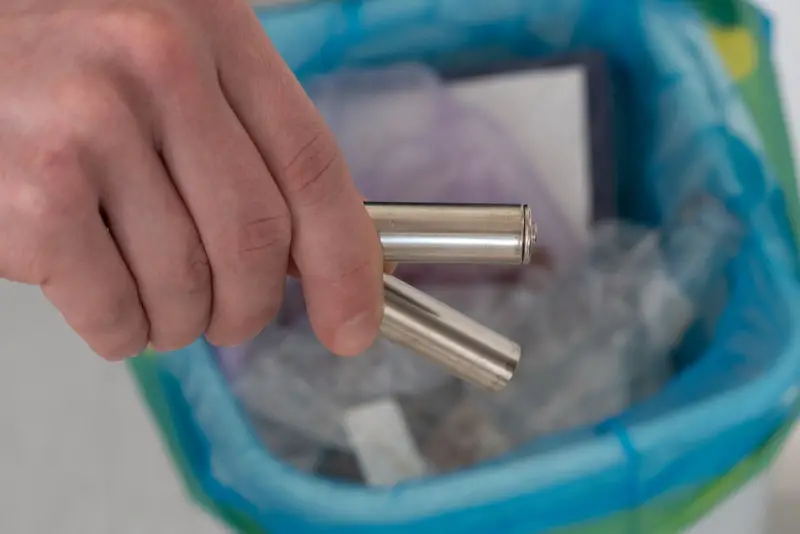
One last surprise for the disposal question. Regular single-use alkaline batteries can legally go in your household trash in every state except California, where throwing any battery in the garbage is against the rules. Lithium-ion is a different story and should be dropped at a battery recycling spot rather than the trash. Most Home Depot and Lowe’s stores have collection bins right up front. So the next time you clear out that chaotic drawer, you will actually know what to do with the pile.
None of this takes real effort. Tape on the 9-volts, keep new stuff in its packaging, pull batteries out of gear you are not using, and stop trusting the fridge. Small changes, and your batteries last longer while your junk drawer stops being a tiny fire hazard.

