

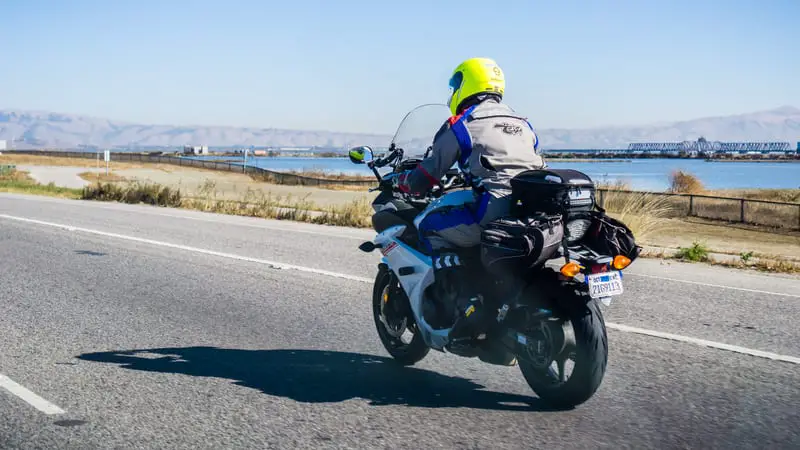
A rider coming the other way on a two-lane road lifts his left hand off the grip, pats the top of his helmet twice, and is gone before you’ve finished processing it. Most drivers file that away as a wave, or an itch, or nothing at all. It’s a warning, and it’s meant for you as much as for the bikes behind him. Something up the road deserves your attention, and more often than not it’s a patrol car with a radar gun.
Riders use the same helmet tap for gravel, deer, construction zones and crash cleanup. But if you stopped a hundred of them at a gas station and asked, the first answer would be cops. Plenty of these gestures get taught in motorcycle training courses, not driver’s ed, which is exactly why the average person in a Honda Civic has no idea what’s being said to them.
The Official Meaning Is Something Else Entirely
The Motorcycle Safety Foundation, whose curriculum sits behind rider training across the country, lists the open-palm helmet tap in its training materials as the signal for high beam headlights. That’s the book answer. Out on the road, close to nobody uses it that way.
The street meaning probably grew straight out of the official one. The tap stands in for flashing your high beams at oncoming traffic, and flashing your high beams at oncoming traffic has meant one thing to American drivers for decades. The gesture kept the message and dropped the headlights. Riders, by the way, call us cagers.
Harley-Davidson doesn’t bother with the debate. Its insurance arm’s hand signal guide lists a pat on top of the helmet as the warning for police or a speed trap ahead, flat out, in the same rundown as the signals for turns, single file and fuel. When the most famous motorcycle brand in America prints the slang version in its own advice, the slang version has won.
One Tap And Four Taps Are Not The Same Message
Where the tap happens tells you what kind of trouble it is. On a long, straight stretch of highway, it’s almost certainly a speed trap, because there’s nothing else out there worth warning anyone about. Near a sharp bend, or on a piece of road with a reputation for wrecks, the same motion is more likely pointing at a physical hazard.
The count matters too. A single tap usually does the job. Repeated taps can mean the hazard is worse, or that it stretches on for a while. And the tap often travels with a second gesture that narrows it down: a hand pointed at the pavement means a pothole, a wave toward the shoulder means debris. That’s context doing the work that a sentence would do if anybody could hear anybody.
Plenty of riders treat distance as part of the code, too. A speed trap gets flagged miles out, since the whole point is giving riders time to settle their speed. Road debris only needs about a quarter mile of notice. If you get tapped and then see nothing for two minutes, that’s not a mistake, that’s the system working as designed.
Sometimes It Just Means Thanks
There’s one situation where the tap carries no warning at all. If you just did something decent for a rider, like leaving them room to merge or holding back instead of crowding their lane, the pat on the helmet is a plain thank you.
So the same gesture means watch your speed and means appreciate you, depending entirely on what happened in the three seconds before it. My advice is to treat every one of them as a warning anyway. Easing off the gas for twenty seconds costs you nothing, and being wrong in the other direction costs you a ticket.
Tipping Off Strangers About A Speed Trap Is Legal
Plenty of riders assume they’re getting away with something. They’re not really. A federal court has treated warning other drivers about police as protected expression under the First Amendment, and the case involved nothing more than flashing headlights at oncoming traffic.
The case people point to involves a Missouri driver named Michael Elli, who was ticketed under an Ellisville city ordinance in 2012 after flashing his headlights at oncoming cars to warn them about a speed trap. The charge was dropped, and he sued the city with help from the ACLU. In 2014, the US District Court for the Eastern District of Missouri found the headlight flashing was likely protected expression and barred Ellisville from ticketing drivers for it.
The legal exposure, where it exists, comes from the lights and not the warning. Flashing high beams between dusk and dawn can give an officer a lighting violation to work with, which is grounds to pull you over and write you up. A gloved hand on a helmet involves no light at all, and most places don’t regulate the gesture specifically. It’s also worth remembering that speed trap reports are a standard feature inside Google Maps, used by millions of people who have never thought twice about it.
Why Riders Tap Instead Of Pointing
The helmet tap beat out the alternatives for reasons that have nothing to do with tradition. It’s visible at highway speed, it’s hard to confuse with anything else, and it takes very little movement from a person balancing several hundred pounds of machine at 70 miles an hour. Stretching an arm out into the wind is a bigger ask than lifting a hand six inches.
It’s also harder for drivers to misread. Car drivers don’t know most motorcycle hand signals, and a pointed arm from a stranger can land as anything from a greeting to an insult. Nobody misinterprets a hand on a helmet.
One detail you’d never notice unless you ride: it’s done with the left hand, always. The right hand runs the throttle and the front brake. That single rule explains the shape of the entire signal system, which is why riders signal a right turn by bending the left arm up at a 90 degree angle instead of just pointing right.
The Vocabulary Is Bigger Than You’d Guess
Left arm out and swinging down with the palm facing the road means slow down. The same arm swinging up with the palm toward the sky means pick it up. A hand opening and closing with the fingers spread is somebody telling you your turn signal has been blinking for the last eleven miles.
Hazards get pointed at. Something on the left gets a left hand. Something on the right gets a right leg stuck out toward it, which looks bizarre from inside a car and makes perfect sense once you remember the right hand is busy.
Then there’s the everyday stuff. A fist held near the jaw with the thumb out, like drinking through a straw, is the refreshment stop signal, and position matters, because up by the ear it reads as a phone call. A finger pointed at the gas tank means somebody’s running low. A fist pumped up and down from waist height is the comfort stop, which is a polite way of saying find an exit. Two fingers held low off the left hand toward the pavement is the respect salute, the one you see traded between riders going opposite directions all summer long.
One Rider’s Signal Becomes The Whole Group’s
Groups usually ride staggered, alternating sides of a single lane rather than side by side. When conditions get tight, the leader raises the left arm straight up with one finger extended for single file, and two fingers when it’s safe to spread back out. Every rider behind repeats it down the line, so the message reaches the last bike before the hazard does.
Three of these signals aren’t optional or cultural at all. Left turn, right turn and stop are written into state traffic law as a legal stand-in for signal lights, which means the arm straight out the window your grandfather used is still legally valid. The Motorcycle Safety Foundation’s group riding chart adds a longer list of standardized signals, covering stop, slow down, speed up, follow me, you lead, single file, double file, hazard, high beam, pull off, turn signal on, fuel, refreshment and comfort stop.
Nobody Knows Who Started It, And It Doesn’t Travel Well
The origin is murky. One theory is that it started with outlaw motorcycle clubs warning each other about police activity, then leaked out to everybody else. What’s certain is that it showed up decades ago, when a rider’s only early warning system was another rider’s hand, long before anyone had a phone mounted to their handlebars.
Bluetooth headsets haven’t killed it, and won’t. Those systems work beautifully inside your own group and are completely useless for warning a stranger going the other direction at highway speed. The tap covers the gap nothing else covers.
Cross a border and the code changes. In Europe, riders tend to flash their headlights to warn about police rather than tapping. Australian riders use their own set. Even here, the usage splits by crowd: cruiser and touring riders lean on the traditional signals, sportbike riders are more likely to just point, and track-day riders may never use the helmet tap at all.
What To Do About It From The Driver’s Seat
Lift off the gas, check your speedometer, and scan the shoulder and the overpasses. Riders who get the warning nod or wave back, ease off, and pass it along to the next person coming the other way, which is how a single tap outside Scranton ends up warning somebody fifty miles later.
The part that gets lost in the argument about whether any of this is fair to law enforcement: drivers who spot a hidden cruiser late do genuinely dumb things. They stand on the brakes when they weren’t even speeding. They change lanes without looking. A warning several miles out produces a car that slows down gradually instead of a car that panics at the last second.
Learn the tap. It costs you nothing, it’s the single most useful piece of road language you’re not already fluent in, and the rider who gave it to you got nothing out of the exchange except the satisfaction of looking out for a stranger. Return the favor by actually slowing down.

