

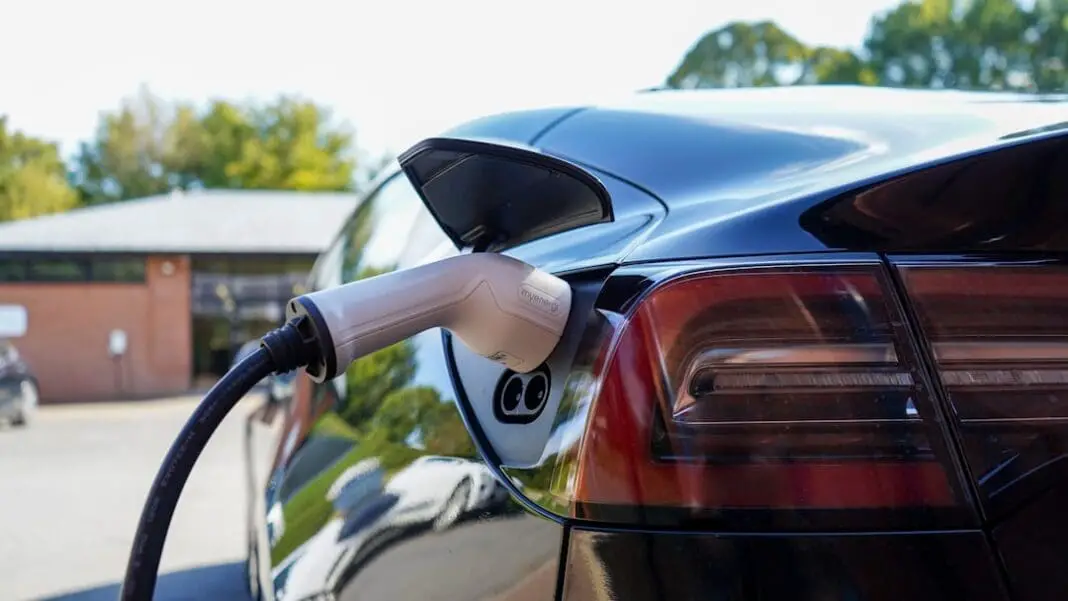
If you’ve been even loosely paying attention to the car market this year, you’ve probably noticed something strange happening. Electric vehicles — the things every automaker swore were the future just three years ago — are dropping like flies. We’re not talking about one or two niche models quietly disappearing from a brochure. We’re talking about a full-blown extinction event across nearly every major brand, from Tesla to Honda to Volkswagen. The list is long, the financial losses are staggering, and the reasons behind all of it are wilder than you’d expect.
Tesla Killed Its Own Flagship — to Build Robots
Let’s start with the big one. The Tesla Model S — the car that basically proved electric vehicles could be cool — is done. Officially discontinued on April 1, 2026, after more than a decade in production and hundreds of thousands of units sold worldwide. The Model X is gone too.
And the reason? It’s not just that sales tanked — though they absolutely did. Model S sales in the U.S. dropped by a third in 2025, and Model X volume was roughly cut in half. The real kicker is what Tesla is doing with the freed-up factory space at its Fremont, California plant. They’re not building a new car. They’re building Optimus humanoid robots. Yes, seriously. Elon Musk called the Model S’s departure an “honorable retirement,” and the production lines are being physically converted to manufacture walking, talking robots instead of sedans.
For context, the Model S Plaid was putting out 1,020 horsepower from three motors, hitting 0-60 in 2.1 seconds, and running a quarter-mile in 9.4 seconds at 151 mph. That car pulled 1.02g on the skidpad. And now the space where it was born is going to make humanoid robots. That’s the world we live in.
Meanwhile, the Model 3 and Model Y made up 97% of Tesla’s 2025 deliveries. Tesla didn’t kill the Model S because it was a bad car. It killed it because almost nobody was buying it compared to the cheaper stuff.
Honda Just Lost $15.8 Billion Walking Away From EVs
This one floored me. Honda didn’t just cancel one EV — they scrapped their entire North American EV program. Three vehicles gone: the Honda 0 Series Saloon, the Honda 0 Series SUV, and the Acura RSX. All three were supposed to be built at Honda’s Ohio plants, where the company had already invested over $1 billion to retool everything as an “Ohio EV Hub.”
The total financial damage? Up to $15.8 billion in losses. Write-offs on tangible and intangible assets alone are expected to run between $5.2 billion and $7 billion. The operating loss for the fiscal year swung by up to $7 billion against what was supposed to be a profitable year. Reports suggest Honda could owe around $10 billion to suppliers who were already geared up to build parts for cars that will never exist.
Honda’s board members forfeited their performance bonuses. Senior executives took 25-30% pay cuts. The CEO who originally committed Honda to being 100% electric by 2040 is the same one who pulled the plug. Honda is now calling it a “Great Reset” and shifting hard toward hybrids. Their hybrid sales went from 5% of overall volume five years ago to over a third today. The CR-V alone sold over 400,000 units last year.
Tariffs Are Absolutely Wrecking Imported EVs
A huge chunk of these cancellations come down to one thing: tariffs. And the numbers are brutal.
The Volvo EX30 is a perfect case study. It launched at around $35,000, which was a genuinely good price for a small electric SUV. But it was originally built in China, which got hit with a 100% tariff on Chinese-made EVs. So Volvo moved production to Belgium. Problem solved, right? Nope — then a 25% tariff on all imported cars kicked in. By the end, the EX30’s price had soared to nearly $50,000. Sales collapsed to just 184 units in October 2025. Dead.
The Kia Niro EV got caught the same way. It was priced at $41,195 — already $4,595 more than the Hyundai Ioniq 5, which is built tariff-free at Hyundai’s plant in Georgia. Add South Korean tariffs on top of an already higher price, and buyers had zero reason to pick the Niro.
Tariffs cost Kia $2.3 billion in 2025 alone. Their operating profit fell from $9.3 billion in 2024 to $6.4 billion. The Kia EV6 GT, the EV9 GT, and the anticipated EV4 — which was supposed to be the affordable one, priced below $40,000 with up to 330 miles of range — all got delayed indefinitely. The only Kia EVs still safe are the ones built in West Point, Georgia.
The Nissan Ariya, built in Japan? Gone. The Genesis Electrified G80, built in South Korea? Gone. The Volkswagen ID. Buzz? Paused for the entire U.S. and Canadian markets. If your EV wasn’t assembled on American soil, 2026 was probably its last year.
The Ford F-150 Lightning Never Made a Dime
Ford stopped producing the F-150 Lightning in December 2025. It debuted for 2022 with enormous hype — an electric version of America’s best-selling truck seemed like a slam dunk. It wasn’t. The Lightning never turned a profit. Not once in its entire production run.
Ford’s replacement strategy is telling. Instead of another pure battery-electric truck, they’re working on a range-extended EV — basically a truck with a smaller battery and an onboard gasoline generator that charges it on the go. Think of it like the old Chevy Volt concept, but in an F-150. Ford says the next-gen truck will have an estimated range over 700 miles. They haven’t announced when it goes on sale.
Ram went the exact same direction. The all-electric Ram 1500 REV — which was supposed to offer 350-500 miles of range on pure battery power — was officially cancelled before it ever launched. Stellantis put it bluntly: “As demand for full-size battery-electric trucks slows in North America, Stellantis is reassessing its product strategy.” The replacement? A range-extended version that still carries the 1500 REV name, but runs a V-6 generator alongside a smaller battery.
The Hyundai Ioniq 6 Died Despite Being One of the Best EVs on the Road
This is arguably the most frustrating cancellation on the list. The Ioniq 6 was a legitimately excellent car — 361 miles of EPA range, one of the fastest-charging EVs tested by major reviewers, sleek design, roomy interior. By every objective measure, it was competitive.
Didn’t matter. Hyundai dropped the standard Ioniq 6 from the U.S. lineup for 2026, leaving only the high-performance Ioniq 6 N in very limited numbers. The problem wasn’t the car — it was where the car was built. The Ioniq 6 comes from a factory in South Korea, which means it carries a 15% import tariff and never qualified for the federal tax credit. Meanwhile, the Ioniq 5 rolls off the line in Georgia, dodging both issues entirely. When your almost-identical corporate sibling costs thousands less because of geography, you’re toast.
The 11-cubic-foot trunk probably didn’t help either. That’s small enough to make packing for a weekend trip annoying.
New EV Sales Cratered, But Used EVs Are Booming
Here’s the twist nobody expected. While new EV sales dropped 28% in the first quarter of 2026 — down to just 212,600 units from 296,304 in Q1 2025 — used EV sales jumped 12% in the same period. About 93,500 used EVs sold in Q1 alone.
The math makes sense. The average used EV now costs $34,821 — only $1,334 more than a comparable used gasoline car. A few years ago, that gap was over $10,000. Used EVs are moving off dealer lots in an average of 42 days, nearly matching gas cars at 38 days. Meanwhile, new EV inventory is sitting at 130 days’ supply, which is absurd compared to 89 days for gas vehicles.
The federal $7,500 new EV tax credit expired on September 30, 2025, after Congress killed it in the One Big Beautiful Bill Act. The $4,000 used EV credit is also gone. Without that incentive, new EVs got a lot harder to justify. But used ones? The depreciation already happened. You’re getting a car that originally cost $50,000-plus for mid-$30,000s money. That’s a deal the tax credit removal actually can’t ruin.
The Industry Just Burned Through $70 Billion in EV Write-Downs
Step back and look at the full picture, and the scale of this retreat is staggering. According to Automotive News, the combined shift away from an all-electric future has cost Honda, General Motors, Ford, and Stellantis roughly $70 billion combined. Ford alone took a $19.5 billion write-off. GM ate $7.1 billion. Honda’s $15.8 billion loss was one of the most dramatic financial reversals in modern automotive history.
Even Lamborghini walked away. They scrapped all-electric versions of the Lanzador and the Urus, with the brand’s boss saying there was only “marginal demand” for all-electric supercars.
The Acura ZDX lasted one single model year — about 19,000 units sold, and that was it. The Sony Honda Afeela, which was supposed to be this futuristic tech-forward sedan, was discontinued before most people even learned what it was.
BMW is one of the few playing this differently. Their iX electric SUV is leaving the U.S. after a five-year run, but they’re replacing it with the iX3, which packs 469 horsepower, 400 miles of range, and arrives this summer. They’re not retreating — they’re swapping out first-generation tech for newer stuff. That’s a very different story than Honda cancelling everything and writing a $15.8 billion check.
There are now about 5.8 million EVs on American roads, and public charging sessions hit 141 million in 2025. The cars aren’t going anywhere. But the era of every automaker racing to build them regardless of whether anyone’s buying? That’s over.

