

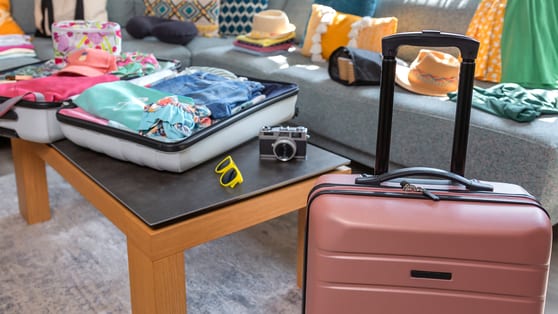
The bag slides into the X-ray tunnel, the belt stops, and an officer walks over and asks whose it is. That question is almost always the moment the owner remembers what is inside. In September, a 27-year-old woman said she went through exactly that at a checkpoint after forgetting a loaded handgun in her carry-on. She started hyperventilating. Officers brought her a chair. She was taken to a room with two TSA officers and two police officers, who took her information and her picture, and she was given the choice of surrendering the gun or being escorted to her car to lock it up.
A loaded firearm found at a checkpoint carries a TSA civil penalty of at least $3,000 and as much as $12,210, plus a criminal referral. A repeat violation can run to $17,062. Few things you can absentmindedly leave in a bag cost that much.
The gun is legal. The bag it is in is the problem.
Flying with a firearm is perfectly allowed. It just cannot ride with you. TSA requires guns to be unloaded, packed in a locked hard-sided container, and declared to the airline at check-in, and the agency tells travelers to confirm with the airline first, because some carriers have their own rules about guns and ammunition in checked bags. Ammunition has to be securely packed in fiber, wood or metal boxes, or in packaging made to carry small amounts of ammunition.
The excuse is always the same one. In late 2023, Pennsylvania State Representative Dan Frankel called for tougher penalties on people caught carrying guns through airport security. “The owners’ response in 100% of the cases was ‘I forgot,'” his office said. Under his proposal, a traveler caught with a gun at a checkpoint could lose their permit to carry. The woman stopped at that checkpoint said afterward that she plans to stop carrying.
Your phone charger is the rule that keeps changing
Power banks and spare lithium batteries go in the cabin, never in a checked bag. That is backwards from how most people assume airport security works, and it is the category that catches experienced travelers more than any other. The reason is simple: a battery that overheats in the hold burns unseen for hours. In the cabin, somebody notices in seconds.
The federal limits have held steady. Rechargeable batteries are capped at 100 watt hours each, airline approval is required between 100 and 160 watt hours, and anything above 160 watt hours is a hard no. What moved in 2026 was the airlines. The FAA counted a record 89 lithium battery smoke and fire incidents on planes in 2024, and carriers started writing rules stricter than the federal floor.
Southwest went furthest. As of April 20, 2026, each passenger gets one power bank rated at 100 watt hours or less, and it cannot sit in an overhead bin. It stays on you or in a personal item under the seat where a flight attendant can grab it fast. Delta allows two power banks of 100 watt hours or less and keeps them out of the overhead bins.
One more trap hides at the end of the jet bridge. If your roller bag gets gate-checked because the bins filled up, every spare battery and power bank has to come out and go with you into the cabin. The bag changes category; the batteries do not get to change with it.
Peanut butter is a liquid, and TSA is not joking about it
The 3-1-1 rule covers liquids, gels, aerosols, creams and pastes, which is a much wider net than most people think. Peanut butter is a gel. So is hummus. So is yogurt, salsa, cream cheese and nut butter of any kind, including the no-stir almond butter that looks solid in the jar. Over 3.4 ounces, it belongs in the checked bag or in the trash can by the belt. This is not a 2026 change. Peanut butter has sat under the liquids rule for years.
Solid food goes through in any amount. Sandwiches, crackers, fruit, granola bars, hard cheese, chocolate, candy and most baked goods are not restricted at all. A protein bar built from roughly the same ingredients as peanut butter clears the scanner without a second look, because the rule is about texture, not nutrition.
Snow globes catch people out. They combine liquid, glass and a dense base inside one sealed object, which is hard for an operator to read cleanly, and the liquid inside still has to meet the 3.4-ounce limit and fit the quart bag. Gel ice packs pass only when they are frozen solid at the moment of screening; slushy or dripping at the bottom and they count as liquid. Powders are their own headache. Protein powder, ground coffee and similar powder-like substances over 12 ounces have to go in a separate bin for screening, because on an X-ray a dense uniform block can hide the shape of something else.
Toy guns count as guns
Water guns and Nerf blasters that look like real firearms are not allowed in a carry-on. Realistic replica weapons have never been allowed through a checkpoint, and a squirt gun shaped like a pistol falls in the same bucket. Parents flying home from a theme park learn this at the belt more often than you would guess. Holsters and rifle scopes, oddly enough, are generally fine.
BB guns and compressed air guns can fly in checked bags, packed under the same rules as firearms. Stun guns, brass knuckles and mace are out of the cabin entirely. Pepper spray is checked only, one canister of up to 4 fluid ounces with a safety mechanism.
Blades, bats and the seven-inch rule
Pocket knives do not fly in the cabin at any blade length, keychain knives included. Multi-tools with blades go in the checked bag. Scissors are allowed if the blades measure under 4 inches from the pivot. Box cutters and loose razor blades are checked only, while cartridge razors, disposable safety razors, electric razors, tweezers, nail clippers and knitting needles all pass without trouble. Plastic and rounded butter knives are fine, which is a sentence that exists because somebody argued about it.
Anything shaped like a club gets screened as a potential club. Baseball bats, cricket bats, golf clubs, hockey and lacrosse sticks, ski poles, pool cues and even bowling pins ride in checked baggage. Tent stakes are out of the cabin, though sleeping bags, tents and tent poles are allowed as far as TSA is concerned, assuming your airline’s size limits agree. Cast iron cookware is checked only. For tools, the dividing line is roughly 7 inches, and hammers, drills and nail guns are specifically prohibited in carry-ons no matter how small.
The short list of things that cannot board at all
Some items are banned from the aircraft completely, carry-on and checked alike. Fireworks, sparklers, flares, gunpowder, blasting caps and novelty bang snaps. Gasoline, lighter fluid, butane, propane, paint thinner and chlorine. Bear spray at any size, in any bag. Torch and jet-flame lighters. Strike-anywhere matches. Alcohol above 140 proof, because of how easily it ignites, which rules out grain alcohol and 151-proof rum. Marijuana, even on a flight between two states where it is legal, because it is still illegal under federal law and officers who find it call the police.
The exceptions inside that list are narrow and worth memorizing. An ordinary disposable or Zippo-style lighter can ride in a carry-on or on your person; in a checked bag it has to be empty of fuel or in a DOT-approved case. One book of safety matches can go in a carry-on, never a checked bag. Vapes and e-cigarettes are cabin-only too, never checked. Spirits between 24 and 70 percent alcohol can be checked up to 5 liters per passenger, and anything at or under 24 percent has no quantity limit in checked bags. All of this is searchable on TSA’s own What Can I Bring database, which carries rulings on hundreds of individual items and settles most arguments in about ten seconds.
Things that sound illegal and are not
Live lobsters fly. In a clear, spill-proof container, they are explicitly allowed in both carry-on and checked bags, and people from coastal states bring them home all the time. Toy lightsabers are allowed. So are strings of Christmas lights, despite how alarming they look on an X-ray. Cleaned and properly packed antlers are allowed. Frozen food and ice packs are allowed as long as they are still rock solid at screening. A blender can go in a carry-on with the blade removed, along with hangers, bottle openers and corkscrews without blades. Horse spurs are generally fine.
Medical supplies get the widest exemption of anything in the system, including an approved portable oxygen concentrator, though you are expected to pull those items out and show them to an officer before screening. Hand sanitizer is back under the 3.4-ounce liquids limit; the 12-ounce pandemic allowance is gone. Pets clear security, subject to whatever the airline says. Wrapped gifts are allowed, but an officer can open them, so wrap at the other end.
Pack so the checkpoint is boring
Most of these rules are years old. The layer actually in motion is lithium batteries, and it is moving airline by airline rather than at the checkpoint, which is why a charger that was fine last trip can be a problem on the next one. Check your carrier’s count before you pack a second power bank.
Everything else comes down to two habits. Treat anything you can spread, pour, pump, squeeze or scoop as a liquid, and keep it under 3.4 ounces in one quart bag that zips all the way shut. Then do the thing almost nobody does: empty the carry-on completely before you pack it, including the pocket you never open. Officers confiscate the shampoo and move on. The loaded gun you forgot about starts at $3,000 and comes with a police report.

