

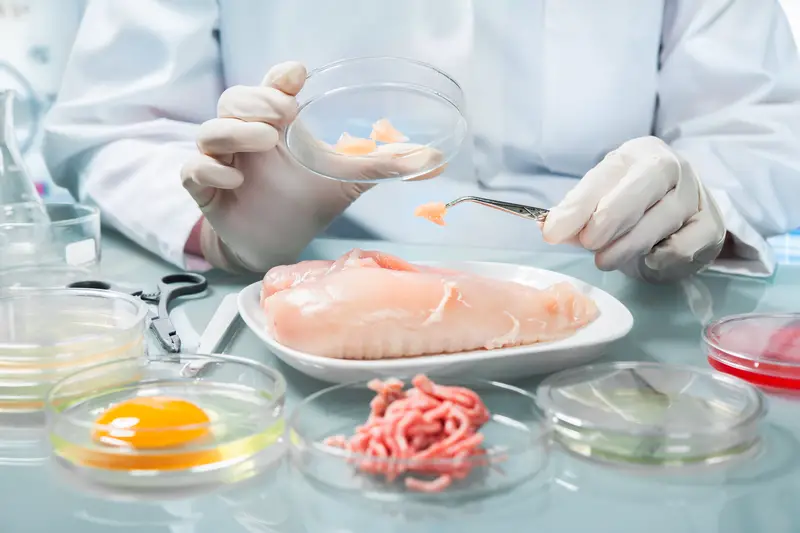
Every year, about 48 million Americans get sick from something they ate. That’s roughly one in six people. Around 128,000 end up in the hospital, and about 3,000 die. These aren’t numbers from the developing world. This is the United States, with all our inspectors and regulations and “best by” dates. And somehow, the food still gets us.
The problem isn’t that we don’t know food can be dangerous. The problem is that by the time anyone figures out what’s contaminated, it’s already been eaten. The lettuce is already in your stomach. The eggs are already scrambled. The recall notice arrives like a postcard from a vacation you already took — except the vacation gave you Salmonella.
But there’s a new generation of food safety technology that’s starting to change that equation, and some of it is borderline science fiction.
From Three Days to One Hour
Here’s something most people don’t realize: the standard way we test food for dangerous bacteria involves growing cultures in a lab. That process takes days. Sometimes two or three days just to confirm whether something like Salmonella or Listeria is present. By then, the contaminated product has shipped, been stocked on shelves, bought, and consumed. The test result is basically an autopsy report for a meal that’s already inside someone.
Researchers at South Korea’s Institute of Machinery and Materials have built something that changes that timeline dramatically. Their fully automated diagnostic platform can detect 16 foodborne pathogens in under an hour. Sixteen. That covers a massive range of the bacteria that make people sick.
The device works by using a high-speed rotating propeller that generates hydrodynamic forces to isolate target organisms from food samples. Multi-layer membrane filtration strips away debris, and the system handles the entire process — from separating the pathogens to purifying the nucleic acids to amplifying and reading the results — all with a single button press. You don’t need a lab tech. You don’t need special training. You press a button and wait.
It can process samples exceeding 200 milliliters, which is a decent volume of liquid — think a bit less than a standard cup of coffee. The project was led by researchers Chanyong Park, Dongkyu Lee, and Changha Woo, and it was developed under Korea’s 2023 Customized Public-Demand Living Safety Research and Development Program. That’s a mouthful of a name, but the point is clear: someone decided that waiting days to find out if food was poisoned was unacceptable.
Another Device Could End Up in Your Kitchen
Meanwhile, at the University of Texas at Dallas, scientists created something even wilder — a portable sensor that could eventually sit in your kitchen drawer. The device, called READ FWDx (Rapid Electroanalytic Diagnostic Food Water Diagnosis), can detect not just bacteria but also chemical contaminants like toxic pesticides and antibiotics — all at the same time, from a single sample.
Traditional testing technology can check for bacteria OR chemicals. Not both. READ FWDx combines 16 sensors with different detection capabilities on a single chip, measuring concentrations of various contaminants from one sample. The technology behind it is called adaptive electrochemical impedance spectroscopy, which is a phrase that means absolutely nothing to most of us but translates roughly to: it reads electrical signals that change when contaminants are present.
The team’s vision is a single-use, portable chip with a year-long shelf life that you could store at home. The project was led by Dr. Shalini Prasad, a professor of bioengineering, who co-founded a company called EnLiSense with her spouse, engineer Sriram Muthukumar, to bring the technology to market. It’s still in proof-of-concept phase, but if it works as hoped, imagine checking your chicken before you cook it the way you check the weather before you leave the house.
Fifteen Minutes Instead of Three Days
A European company called Sensip-dx is working on sensor technology that shrinks the detection window even further — from the traditional three-day culture method down to about 15 minutes. Their system works by flowing a sample fluid over a sensor surface where matching bacteria bind to specific action points. The sensor then measures thermal resistance to confirm the pathogen’s presence.
Think about what that means for a food processing plant. Right now, if a facility suspects contamination, they send samples to a lab, wait days, and either halt production (losing huge amounts of money) or keep going and hope for the best. With a 15-minute test, a plant can test rinse water, ingredient samples, or contact surfaces during active production and make corrections on the spot. No more recalls after distribution. No more guesswork. Sensip-dx says the sensors work across all known foodborne bacterial pathogens and is developing prototypes with early business partners now.
Why This Matters: The Recall System Is Broken
If you think the recall system protects you, here’s a reality check. In 2025, U.S. food regulators announced 28 foodborne illness outbreaks. Out of those 28 investigations, recalls weren’t announced in 17 cases. That means in more than 60% of outbreaks where people got sick, there was no recall. The exact contaminated product couldn’t even be identified.
It gets worse. At least 13 recalls in 2025 involved expansions — meaning the initial recall didn’t capture the full scope of contamination. One infant formula recall connected to a botulism outbreak took nearly two years from the first illness before regulators identified the product. A recall of frozen supplemental shakes linked to Listeria took more than six years.
Six. Years. People were getting sick from a contaminated product for six years before anyone pulled it.
And the FDA doesn’t always post public announcements for life-threatening recalls. In January 2025, an FDA spokesperson confirmed in an email that not all recalls get press releases. A company called Newly Weds Foods recalled 3,500 pounds of breadcrumbs for possible Listeria contamination in July 2025, and there was no public announcement whatsoever.
The CDC estimates that for every case of foodborne Salmonella that’s actually detected, there are 29 more that aren’t. With 1,003 documented outbreak cases in 2025, the real number of people who got sick was almost certainly tens of thousands.
The Traceability Rule That Keeps Getting Delayed
There was supposed to be a fix in the works. The FDA’s Food Traceability Rule was designed to require detailed recordkeeping for high-risk foods — things like cheeses, eggs, nut butters, leafy greens, certain fruits and vegetables, fish, and ready-to-eat salads. The idea was simple: if something is contaminated, you should be able to trace it back to its source within 24 hours.
The rule was originally set for January 2026 compliance. It’s been pushed back to July 2028 — a 30-month delay. The FDA acknowledged the original timeline was too short for the industry to actually pull off. Meanwhile, five of the ten recalls that triggered cascading recalls in 2025 involved foods that were on the traceability list. The very foods the rule was supposed to protect were the ones causing chain-reaction contamination events.
Baby Formula and the Chemicals in Your Baby’s Food
For the first time in decades, the FDA is launching a full review of nutrient requirements for infant formula in 2026. This follows an independent nonprofit testing 41 formulas in 2025 and finding that nearly half contained potentially harmful levels of at least one toxic chemical — arsenic, lead, BPA, acrylamide, or PFAS.
Under the FDA’s “Closer to Zero” initiative, the agency plans to establish action levels for cadmium and inorganic arsenic in baby and toddler foods in 2026. That means setting specific limits on how much of these contaminants can be present. Right now, the contaminants exist because arsenic, lead, cadmium, and mercury are in the environment and make their way into the food supply. They’re not added on purpose — they just end up there, and until now there hasn’t been enough regulatory pressure to force them out.
Other Detection Breakthroughs You Haven’t Heard About
In 2024, researchers at the New Jersey Institute of Technology developed a fast method for detecting PFAS — the “forever chemicals” — in food packaging, water, and soil using paper spray mass spectrometry. A test kit includes a drop dispenser, paper-based devices, and a heating imager. You swab a sample, add it to the dispenser, and within an hour you’ve got contamination levels. A patent application has been submitted and licensing was issued to a startup that’s raising capital to bring it to market.
Researchers at Penn State showed they could monitor foodborne pathogens through wastewater — isolating Salmonella from wastewater samples and using whole genome sequencing to genetically link those samples to a known salmonellosis outbreak. Think about that: testing the sewage system to figure out if a community has a food contamination problem before doctors start seeing patients.
And at Rutgers and Columbia, researchers developed a technique using stimulated Raman scattering microscopy to detect nanoplastics in bottled water. What they found was 10 to 100 times more plastic particles than previous estimates based on larger particles. So that bottled water you’re drinking? It’s got a lot more plastic in it than anyone thought.
The science is moving fast. The regulatory machinery is moving slow. And in that gap between invention and adoption, people keep getting sick from food that could have been tested, caught, and pulled before it ever reached their plate. The tools exist — or will very soon. Whether they’ll be used widely enough, quickly enough, is a different question entirely.

