

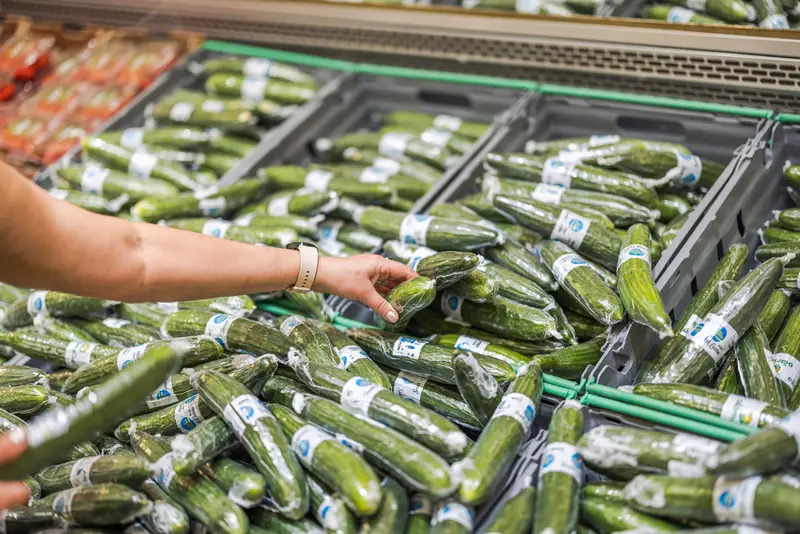
You grab a cucumber at the store. It’s wrapped in plastic. You pick up some bell peppers. Also wrapped in plastic. The organic tomatoes? Sitting in a little plastic clamshell like they’re jewelry at Tiffany’s. Meanwhile, the regular tomatoes are just loose in a bin, naked and free.
If you’ve ever stood in a produce section and thought “why is all of this wrapped in plastic?” — you’re not alone. But the answer is weirder and more layered than you’d expect. It’s not just about keeping your food fresh. In fact, for a lot of produce, the plastic isn’t doing much for freshness at all.
It’s Really About Something Called “Shrink”
In grocery retail, there’s a term for produce that spoils before anyone buys it: shrink. And shrink is the thing that keeps grocery store managers up at night. Every bruised peach, every wilted head of lettuce, every bag of grapes that turns to mush — that’s money down the drain.
Plastic wrapping is, above all else, a financial decision. It reduces dehydration, which means produce looks sellable for longer. It protects against bruising during transport. And it lets stores slap a UPC barcode on individual items, which speeds up stocking and checkout. That’s it. That’s the core of it. Money, speed, and logistics.
This is especially true for organic produce. Organic items cost more to grow, so when they spoil before selling, the financial hit is bigger. One rotten organic apple can spread decay to the ones next to it. Wrapping items individually isolates them — like putting each piece of produce in its own little quarantine pod.
Organic Rules Actually Require the Separation
Here’s something most people don’t know: organic produce, by regulation, cannot be stored in direct contact with conventional produce. That’s a real rule. So when you see an organic bell pepper individually shrink-wrapped while the non-organic version sits loose in a pile, that’s not random — it’s compliance.
Stores need a fast, cheap way to keep organic and conventional items physically separated, even when they’re sitting on the same shelf. Plastic does the trick. Could they use separate display bins? Sure. But that takes more floor space, more labor, and more equipment. Wrapping an organic cucumber in a thin film costs almost nothing and solves the problem instantly.
A shopper in Michigan once documented the difference at her local store: organic green beans came in microwavable plastic bags, organic tomatoes in clamshell containers, and bell peppers shrink-wrapped one by one. The non-organic versions of the exact same items? Completely unwrapped. Same food, different packaging rules.
The Aldi Model Shows What’s Really Going On
If you want to understand the plastic-wrapped produce situation, look at Aldi. Almost everything in their produce section is wrapped: cucumbers, lettuce, blueberries, potatoes, bell peppers, tomatoes, apples, mandarins, zucchini, husked corn, kiwi, fresh herbs — even jalapeños. Jalapeños.
Why? Because Aldi runs on speed and minimal labor. At a typical grocery store, employees can spend up to 35 work hours per day — spread across multiple workers — just unboxing, stocking, and arranging the produce section. That’s a lot of paid labor just to make a pile of apples look nice. Pre-wrapped produce slashes that time dramatically. Workers open a box, put the items on the shelf, and move on. No arranging, no spraying, no rotating. Done.
For customers, the wrapping eliminates the need to weigh anything. No scale, no guessing how much you’re spending. Cashiers just scan a barcode. For a chain that already catches heat for long checkout lines, that scanning speed matters.
But there’s a catch. Aldi shoppers constantly complain about produce quality. And there’s a real reason for that: plastic-wrapped produce traps the heat and moisture that plants naturally release through respiration. That trapped warmth and dampness creates a mini greenhouse around your cucumber — which is great for about 48 hours and then becomes a fast track to rot. Aldi tries to manage this by restocking daily, but it doesn’t always work.
For Some Produce, the Plastic Actually Works
Now, before this turns into a pure anti-plastic rant, there’s a real wrinkle here. For certain items — and under certain conditions — plastic wrapping genuinely extends shelf life by a dramatic margin.
The best example is the cucumber. Research has shown that wrapping a cucumber in just 1.5 grams of plastic film can extend its shelf life from 3 days to 14 days. That’s almost five times longer. For a cucumber that’s been imported — maybe flown in from another country — that extra shelf life is the difference between arriving sellable or arriving as compost.
Grapes are another example. Selling grapes in plastic bags or trays has reduced in-store wastage by 20%. That’s not a trivial number when you think about how many bunches of grapes a single Kroger or Walmart goes through in a week.
The issue is that what works for imported cucumbers doesn’t necessarily work for locally grown ones. When produce comes from a farm 30 miles away, it doesn’t need the same protective cocoon as something that was harvested in another hemisphere and spent days on a plane or cargo ship. Several European retailers tried removing plastic wrapping from cucumbers and saw food waste spike — but only for imported products. The local stuff was fine without it.
But for Most Produce, the Plastic Doesn’t Do Much
Here’s where it gets frustrating. A major 18-month study by the UK nonprofit WRAP tested broccoli, potatoes, apples, bananas, and cucumbers stored at different temperatures, both wrapped and unwrapped. Their conclusion? For most items, the plastic packaging made little or no difference to shelf life.
What actually mattered was temperature. Storing food in a fridge below five degrees Celsius gave produce days, weeks, and in the case of apples, months of additional quality life. The plastic was basically irrelevant compared to just keeping things cold.
By the researchers’ math, plastic packaging combined with misleading date labels wastes over 10,300 tons of plastic and roughly 100,000 tons of food every year in the UK alone. That’s 14 million shopping baskets’ worth of food, thrown out. Not because it was bad, but because it had a date printed on it and people panicked.
The Packaging Makes You Buy More Than You Need
This is the part that doesn’t get talked about enough. When produce is pre-wrapped in fixed quantities — say, a bag of six apples or a tray of four tomatoes — you can’t just buy two. You’re locked into whatever amount the store decided to package. That means you often buy more than you need, and the extra goes bad before you eat it.
When people can pick their own quantity and use their own senses to judge whether something is still good — squeeze the avocado, smell the melon — they actually waste less food. Fixed-size packaging removes that judgment from the equation and replaces it with a printed date that might not mean anything.
Those “best by” and “sell by” dates on pre-wrapped produce? They don’t reflect when food becomes dangerous to eat. They’re manufacturer estimates of peak quality. But most people treat them as expiration dates and toss perfectly good food into the trash.
The Recycling Argument Is Basically a Fantasy
You might think, “well, at least I can recycle the plastic.” You almost certainly can’t. Only two types of plastic actually get recycled in any meaningful volume in the U.S.: PET (used for soda bottles) and HDPE (used for milk jugs and cleaning product containers). The thin plastic film on your wrapped cucumber? That’s not either of those.
There are seven types of plastic polymers, and while the technology exists to recycle all of them, most domestic recycling facilities can’t sort and process different types separately because of the different chemicals involved. The thin wrappers on produce are basically guaranteed to end up in a landfill or incinerator.
Plastic packaging makes up nearly a quarter of all garbage ending up in U.S. landfills, according to the EPA, with the majority coming from food or beverage products. In the UK, only 12% of plastic waste actually gets recycled. Of the rest, 46% gets incinerated — releasing toxic gases and more than two tonnes of CO₂ for every tonne of dense plastic burned — 25% goes to landfill, and 17% gets shipped off to other countries to deal with.
The Food Waste vs. Plastic Waste Argument Is Complicated
Here’s the uncomfortable truth that makes this issue so messy: food waste might actually be worse for the environment than plastic waste. Estimates from Zero Waste Scotland found that 456,000 tonnes of household food waste contributed to about 1.9 million tonnes of CO₂ — three times higher than the carbon footprint from 224,000 tonnes of plastic waste.
That’s a real number. When food spoils and gets thrown away, all the water, energy, fertilizer, transportation fuel, and labor that went into growing and delivering it is also wasted. A rotten head of lettuce doesn’t just represent a lost head of lettuce — it represents every resource that was consumed getting it from a farm to your kitchen counter.
So the calculation isn’t simply “plastic bad.” It’s “does this specific piece of plastic, on this specific item, prevent enough food waste to justify its existence?” For an imported cucumber traveling thousands of miles, probably yes. For a locally grown apple at a farmers market, absolutely not.
The real answer, as boring as it sounds, is that we ship food way too far and then use plastic as a Band-Aid for the distance problem. Shorter supply chains mean less need for protective packaging. But shorter supply chains mean seasonal eating, regional sourcing, and a produce aisle that looks a lot less tropical in February. And Americans aren’t exactly lining up for that trade-off.

