

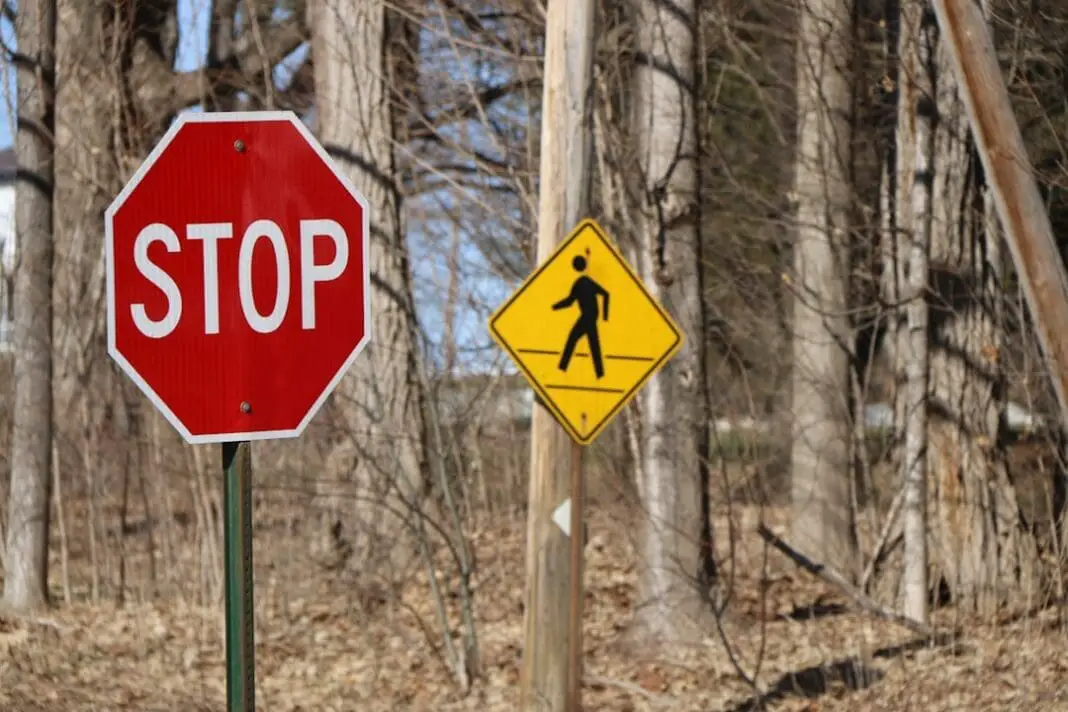
You’ve probably driven past thousands of stop signs in your life without giving them a second thought. Red octagon, white letters, done. But if you’ve ever paused long enough to actually look at one up close, you might have noticed something weird: tiny, perfectly round holes punched into the red metal around the word STOP. Not through the letters. Around them.
Your first instinct might be that somebody used the sign for target practice. And honestly, that’s a fair guess, because people absolutely do that (more on that later). But those clean little circles? They’re not from bullets. They’re there on purpose, and the reason is way more interesting than you’d expect.
They’re Engineered to Let Wind Pass Through
Here’s the short version: those holes exist so the sign doesn’t get ripped off its post during a windstorm. A flat piece of metal mounted on a pole is basically a sail. When a serious gust hits it head-on, the force has nowhere to go. The sign bends, the post wobbles, and eventually the whole thing topples over or snaps off.
By punching small, evenly spaced perforations into the sign panel, engineers let air pass through instead of slamming against a solid surface. It’s the same basic principle behind why a chain-link fence survives a hurricane better than a wooden privacy fence. Less surface area for wind to push against means less force on the structure.
The practice isn’t universal. You’re most likely to see perforated signs in flat, open areas or coastal regions where sustained high winds are a constant problem. Think Wyoming, the Texas panhandle, Florida, Louisiana. Places where a 50 mph gust in February isn’t unusual, it’s just Tuesday.
The Science Behind the Holes Is Surprisingly Specific
You might assume that any holes would help, and that more holes would be better. But it’s not that simple. A 2020 study published in the journal PLOS One used computational fluid dynamics simulations to figure out the exact best sizes and spacing for these perforations. The researchers found that holes between 30 millimeters and 60 millimeters in diameter work best for the areas closest to the sign’s lettering, with spacing set at four to five times the hole radius.
Bigger holes, between 90 and 120 millimeters, work better for the zones between the lettering and the sign’s outer edge. And for the very edge of the sign, where wind force is strongest, holes can go up to 150 to 180 millimeters. The spacing rules change too. Near the edges, the holes can be closer together because there’s no message to protect.
Here’s a detail that surprised me: the relationship between perforation size and wind speed matters a lot. At wind speeds above about 78 mph (35 meters per second), the perforations basically stop helping. At that point the force is so extreme that holes alone can’t save the sign, and you need a completely different support structure to keep things standing.
A separate 2023 study tested overhead highway signs and found that a panel with 25% porosity (meaning a quarter of the surface area is open holes) reduced wind force by about 15.6% compared to a solid panel. But here’s the counterintuitive part: lots of tiny holes actually performed worse than fewer, larger holes at the same total porosity. Two hundred small square holes only cut wind force by about 5.8%, while 28 large holes reduced it by nearly 16%. Bigger openings move air more efficiently than a bunch of small ones.
How Wyoming Helped Pioneer the Whole Thing
Before any of this became real engineering science, road crews in Wyoming were already solving the problem the old-fashioned way. The state’s relentless wind, which regularly gusts over 60 mph across the open plains, was destroying signs faster than crews could replace them. So workers started drilling holes into the signs themselves, just trying to keep them upright.
It worked. Not perfectly, not with any scientific precision, but well enough that the practice became something of a local tradition. The holes were never formally adopted as an official engineering standard at the time, but the DIY approach clearly influenced what came later.
The real shift happened in the 1990s when the American Association of State Highway and Transportation Officials (AASHTO) published new wind load guidelines in 1994. Federal standards started requiring engineers to actually account for extreme gusts and dynamic wind pressure in sign design. Around the same time, the National Cooperative Highway Research Program ran full-scale vehicle crash tests that led to Report 350, which set benchmarks for breakaway post designs. Wind tunnel testing replaced trial-and-error. Laser and CNC cutting machines replaced hand drills. What started as Wyoming road crews improvising became a precise manufacturing process.
How to Tell Engineering Holes From Bullet Holes
This is where things get interesting, because both types of holes exist on American road signs, sometimes on the same sign. And they look completely different once you know what to look for.
Intentional perforations are perfectly circular, uniform in size, evenly spaced, and always placed outside the message area. They’ll be clean, deburred punctures with no rough edges. The pattern is symmetrical. If you see a stop sign with a neat grid of identical circles in the red area around the white letters, that’s engineering.
Bullet holes are the opposite. They’re scattered randomly, often clustered around the center or the lettering (because that’s what people aim at). The entry and exit points show visible deformation, with bent metal pushed inward or outward. The edges are ragged, sometimes cracked, sometimes discolored from rust because the protective coating got destroyed. Even large-caliber rounds don’t create the neat, clean openings you see on a manufactured sign. The two aren’t really easy to confuse once you know the difference.
Shooting Road Signs Is a Shockingly Expensive Problem
Americans spend more than $50 million a year replacing vandalized traffic signs, according to the U.S. Department of Transportation. An estimated 30 to 40 percent of all sign replacements happen because someone shot at, stole, or defaced a sign. That’s your tax money, just to put back what was already there.
In North Dakota, where the problem is especially bad, Cass County alone replaced about $15,000 worth of signs in a single year. A typical sign costs $100 to $150 before you count the labor to install it. In bad years, one county’s vandalism bill can hit $40,000. Dale Heglund, director of the North Dakota Local Technical Assistance Program, has said some counties replace half their signs every year because of vandalism. Half.
And there’s a frustrating irony to it: newer signs are targeted more often. The fresh, highly reflective surface makes a more satisfying target. So the counties that invest in brand-new, bright, easy-to-read signs are the ones most likely to see them shot up within weeks.
Vandalized Signs Have Actually Killed People
This isn’t just about wasted money. Bullet holes destroy a sign’s retroreflective surface, which is the special coating that bounces your headlights back at you so you can read the sign at night. A shot-up stop sign might be readable in daylight but completely invisible after dark. According to the Federal Highway Administration, even if a damaged sign still functions during the day, leaving it up sends the wrong message and may encourage more vandalism.
In seven states that actually track this data, an average of two deaths per year have been directly attributed to vandalized or stolen signs. One case in Florida is especially grim: three teenagers went out one night and uprooted or stole about 19 signs on rural roads. Hours later, three other teenagers drove into an intersection where a stop sign had been pulled from the ground and was lying on the roadside. All three were killed. The vandals were convicted of manslaughter and sent to prison.
North Dakota State University launched a program called “Sign Warriors” to try to change the culture. They partnered with the state’s Game and Fish Department to bring bullet-riddled signs into hunter education classes, showing young hunters what happens when you use road signs for target practice. It’s a small effort against a big problem, but it’s at least a start.
Street Sign Theft Is Its Own Weird Subculture
Bullet holes aren’t the only vandalism problem. Street sign theft is surprisingly common, and the targets are predictable. Signs named after famous places, cultural references, or anything that sounds funny tend to disappear constantly. Streets named Abbey Road get stolen so often that some cities have given up on mounting traditional signs and just paint the name directly on the curb.
Missing street signs also create a problem most people don’t think about: emergency responders can’t find addresses. Even with GPS, a missing sign at a critical turn can add precious minutes to a response time. It’s the kind of consequence that never crosses someone’s mind when they’re pulling a sign off a post at 2 a.m. to hang on their dorm room wall.
Next Time You’re at a Stop Sign, Look Closer
There’s something kind of satisfying about knowing that a random detail you’ve probably noticed but never questioned has this much thought behind it. Those little holes aren’t damage. They’re not manufacturer defects. They’re the result of decades of wind tunnel testing, fluid dynamics research, and hard-learned lessons from places like Wyoming where the wind just will not quit.
And if you see a stop sign covered in random, jagged holes of different sizes? That’s not engineering. That’s someone treating public infrastructure like a shooting range. And the rest of us are paying for it.

