

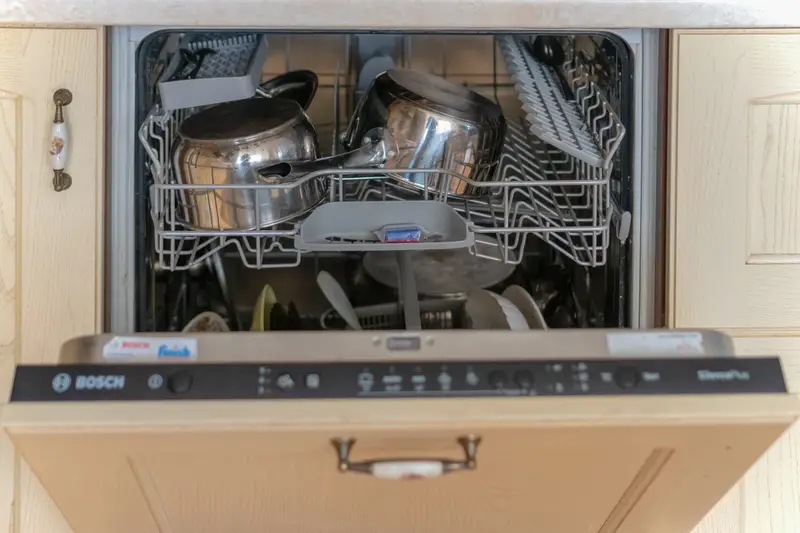
I’m going to go out on a limb here and guess that nobody ever taught you how to load a dishwasher. You just sort of… figured it out. Watched your parents do it, crammed stuff in there, hit start, and hoped for the best. And honestly, that’s how most of us operate. But here’s the uncomfortable truth: roughly 80 percent of dishwasher users are making common loading mistakes that leave their dishes dirty, damage their machine, or both.
Even wilder? According to Dennis Godynuk, a licensed appliance repair expert with Comfort Appliance Repair of Tennessee, about 70 percent of his service calls aren’t even real mechanical problems. They’re loading and maintenance issues. People are paying a repair tech to come out and basically tell them they’re stacking plates wrong. Let that sink in for a second.
So yeah — the way you fill your dishwasher matters a lot more than you think. And some of the stuff you’re doing “right” is actually making things worse.
Stop Rinsing Your Dishes Before You Load Them
This is the big one. The thing that causes the most arguments in kitchens across America. Your instinct says: rinse the plate before it goes in. Get the gunk off. Give the dishwasher a head start. Makes total sense, right?
Wrong. Dead wrong.
Modern dishwashers have sensors inside that detect how dirty the water is. The machine uses that information to determine how long and how hard to run the cycle. When you pre-rinse everything until it’s practically clean, the sensor thinks the load is barely dirty. So it runs a lighter, shorter cycle — and the stuff that actually needed scrubbing doesn’t get it.
But wait, it gets even more counterintuitive. Many dishwasher detergents contain enzymes specifically designed to break down food particles. Those enzymes need something to cling to. When you rinse all the food off, the detergent has nothing to work with. It’s like hiring a demolition crew and then tearing down the building yourself before they arrive.
What you should do: scrape off the big chunks. Bones, corn cobs, big pieces of stuck-on food — get those off. But that thin layer of pasta sauce? The smear of peanut butter? Leave it. Your dishwasher was literally built to handle that. You’re wasting water, wasting time, and getting worse results by rinsing.
Overcrowding Is the Silent Killer of Clean Dishes
I get it. Nobody wants to run two loads when you can cram everything into one. That Tetris impulse kicks in and suddenly you’re wedging a colander sideways behind three mixing bowls. Efficient? Feels like it. But your dishwasher doesn’t clean with magic — it cleans with water. Specifically, pressurized hot water shot through rotating spray arms.
If the spray can’t reach a surface, that surface doesn’t get clean. Simple as that. Hannah Pregont, an appliance expert at AJ Madison, confirms that overloading blocks both water and detergent from reaching dish surfaces. You end up running the cycle, unloading, and then hand-washing half the stuff anyway. You didn’t save time. You doubled your work.
The fix is less dramatic than you’d think. Leave a little breathing room between items. Make sure nothing is nesting — bowls stacked inside bowls, spoons spooning other spoons. Everything needs its own space so water can hit it from multiple angles. If a plate is completely hidden behind a cookie sheet, that plate is just going for a steam bath, not getting washed.
You’re Probably Blocking the Spray Arms Without Knowing It
Here’s a test most people have never done: before you close the dishwasher door and hit start, reach in and spin the spray arms with your hand. Can they rotate freely? Or does that tall wooden spoon handle or the edge of a cutting board stop them mid-turn?
If anything blocks those arms, you’re essentially running a cycle where water only hits part of the load. That cutting board you wedged in the bottom rack? It might be acting like a shield, deflecting water away from everything behind it. Large items like baking sheets and cutting boards should go along the sides and back of the bottom rack — never in the center where they’ll interfere with water distribution.
Long-handled utensils are another sneaky offender. A ladle or spatula sticking up too high from the bottom rack can physically stop a spray arm from spinning. One blocked utensil can ruin an entire load’s worth of cleaning.
Top Rack vs. Bottom Rack Actually Matters
Most people treat the two racks like they’re interchangeable — just put stuff wherever it fits. But the top and bottom racks deliver very different cleaning experiences. The bottom rack gets stronger water pressure and higher temperatures. The top rack is gentler.
This means your heavy hitters — dinner plates, serving bowls, pots, pans, casserole dishes — belong on the bottom. They can handle the intensity. Glasses, cups, small bowls, and anything plastic should go on top, away from the heating element that sits at the bottom of most machines. Put a flimsy plastic container on the bottom rack and you might open the door to find it warped into modern art.
And those plates on the bottom? They should all face toward the center of the machine, where the spray arm jets are strongest. Angle them slightly downward so water drains off instead of pooling. If you’ve ever unloaded the dishwasher and found little puddles of gross gray water sitting in the bottom of bowls, it’s because those bowls were angled wrong or facing up.
The Silverware Basket Has Rules Too
Forks with forks. Spoons with spoons. That’s how most people load the silverware basket, and it’s another one of those intuitive-but-wrong approaches. When identical utensils are grouped together, they nest. Spoons cuddle up against each other like sardines and the water can’t get between them.
The better move is to mix everything up — a fork, then a spoon, then a knife, then a fork. This prevents nesting and lets water reach every surface. Spoons and forks should go handle-down so the dirty eating end gets the most water exposure. Knives go handle-up, for the obvious reason that you don’t want to stab yourself reaching into the basket.
If your machine has a third rack — a lot of newer models do — use it for longer utensils like spatulas, tongs, and ladles, plus small items like jar lids and measuring spoons that tend to fall through the regular racks.
Things That Should Never Go in the Dishwasher
Some stuff just doesn’t belong in there, no matter how tempting it is. Cast iron is the classic example — the dishwasher strips away the seasoning you’ve spent months building up and can cause the pan to rust. Non-stick pans are almost as bad; over time, the high heat and harsh detergent erode the coating. That “dishwasher-safe” label on some non-stick pans? Even manufacturers admit it’s not great for the pan long-term.
Wood items — cutting boards, wooden spoons, knives with wooden handles — will warp, crack, and dry out in the dishwasher. The detergent is abrasive enough to scratch the surface, and the drying cycle’s heat does the rest. Copper and aluminum cookware can discolor. Crystal and delicate hand-blown glass can yellow or develop a cloudy etching that’s permanent.
Insulated travel mugs are another one people miss. The dishwasher can break the vacuum seal that keeps your coffee hot, turning your $30 Yeti into a regular cup. And graters and zesters? The dishwasher dulls their edges and misses food particles trapped in all those tiny holes. You still have to scrub them by hand afterward, so you might as well just do it right the first time.
Your Detergent Placement Matters More Than You Think
If you’ve been tossing your detergent pod loose into the bottom of the dishwasher tub, stop. The pod needs to go in the detergent dispenser compartment. That little door isn’t just decorative — it’s timed to open at the right point in the wash cycle. If the pod dissolves immediately when water hits it at the start, you lose detergent during the initial rinse before the main wash even begins.
Speaking of pods: Consumer Reports testing found that the best-performing pods clean better than the best gels, liquids, or powders. Pods also prevent the over-dosing problem. When people pour liquid or powder detergent, they almost always use too much, which leaves filmy residue on dishes. One pod, one load, done.
Oh, and handle pods with dry hands. The coating is polyvinyl alcohol — it’s designed to dissolve in water. Wet fingers can start breaking it down before it ever reaches the machine.
One Last Trick Nobody Does
Before you start a load, go to your kitchen sink and run the hot water tap until the water coming out is actually hot. Most people skip this, and it means your dishwasher spends the first several minutes of the cycle trying to heat up lukewarm water instead of cleaning. A hot water start means the machine reaches its effective cleaning temperature faster, and your dishes come out noticeably cleaner.
While you’re at it, check that your water heater is set to at least 120 degrees Fahrenheit. If it’s lower, even a perfectly loaded dishwasher with premium detergent will struggle. The dishwasher is one of the best inventions in any American kitchen — but only if you let it do its job the way it was designed to. Stop fighting it. Stop pre-rinsing. Stop cramming. Load it right, and you might be surprised at what that machine can actually do.

