

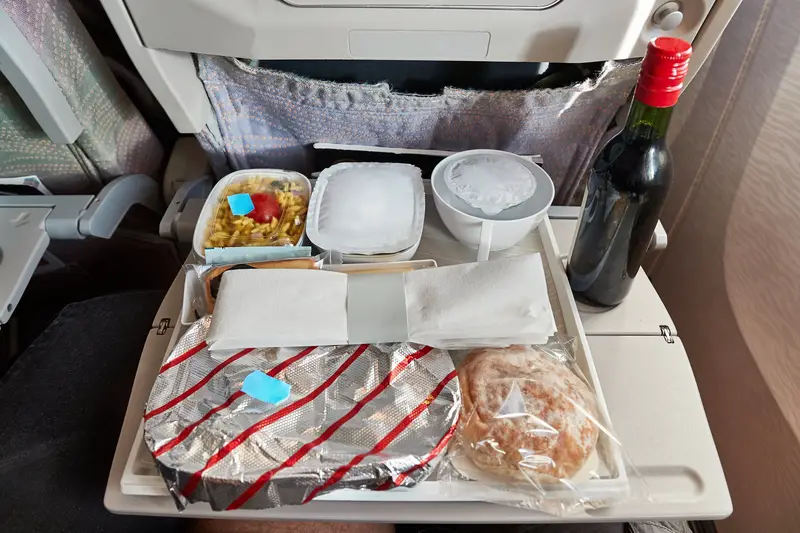
You’re 35,000 feet in the air, crammed into seat 27B, and the flight attendant rolls the cart past you because you were asleep. That chicken-or-pasta meal they made for you? It exists. It was prepped, packed, loaded, and flown across the country with your name — well, your seat number — essentially on it. But you never ate it. Neither did the guy in 14A who brought his own Chick-fil-A, or the woman in 22C who just wasn’t hungry.
So what happens to all that food? The answer is worse than you think, weirder than you’d guess, and tied up in international law, federal regulations, and the brutal economics of feeding people in a metal tube screaming through the sky at 500 miles per hour.
Most of It Goes Straight Into the Garbage
Let’s get the ugly part out of the way first. The vast majority of uneaten airline food gets destroyed. Not donated. Not composted. Not fed to anyone. It goes into the trash — sealed containers, unopened packages, untouched fruit cups, all of it. The International Air Transport Association (IATA) has estimated that airlines generate roughly 6.7 million tons of cabin waste per year, and a large chunk of that is food. We’re talking about an industry that throws away enough uneaten meals annually to fill tens of thousands of garbage trucks.
And it’s not because airlines are heartless or lazy. Well, not entirely. The reasons are a tangle of customs regulations, biosecurity laws, and cost calculations that make donation or repurposing incredibly difficult. Most airlines have decided that the cheapest, easiest option is to just chuck it.
International Flights Are the Worst Offenders — And There’s a Reason
Here’s where it gets interesting. If you’re on a domestic flight within the U.S., leftover food at least has a theoretical chance of being saved. But on international flights? Everything gets destroyed once the plane lands. Every last bread roll. Every sealed yogurt. Every sad little bag of pretzels.
The reason is biosecurity. The USDA and its equivalents in other countries are terrified — and reasonably so — that food from foreign nations could carry pests, diseases, or invasive species. A single piece of fruit from South America could theoretically introduce a pest that devastates American agriculture. So customs regulations in the U.S. (and in most countries worldwide) require that all food waste from international flights be treated as regulated garbage. That means it has to be incinerated or sent to an approved landfill. No exceptions.
This rule applies even if the food was originally sourced in the destination country. Say a flight from London to JFK loaded meals prepared with American-sourced ingredients during a stopover. Doesn’t matter. Once it crosses an international border on a plane, it’s legally considered foreign agricultural waste. Into the incinerator it goes.
The Numbers Are Staggering
A single long-haul wide-body aircraft can carry over 300 passengers, and airlines typically load about 10-15% more meals than there are passengers on board. That buffer exists because of dietary choices — they need to have enough chicken if everyone picks chicken, enough vegetarian meals for those who want them, and so on. But that buffer means that on every single flight, there are dozens of meals that were never going to get eaten no matter what.
Multiply that by the roughly 100,000 flights that operate worldwide every single day, and the scale becomes absurd. Some estimates put the total airline food waste at around 5.7 million tons per year — that’s food waste alone, not counting cups, napkins, plastic wrap, and utensils. To put that in perspective, that’s roughly equivalent to the weight of about 1.5 million mid-size cars. Every year. Just in thrown-away airline meals.
A Few Airlines Are Trying to Do Something About It
Not everyone in the airline industry is content with the dump-it-all approach. American Airlines, for example, has started a program to repurpose food waste into compost. The airline works with waste management partners at certain hubs to separate organic food waste from other cabin trash and turn it into something useful rather than just burying it in a landfill. It’s not a perfect system — it only works at select airports, and it still doesn’t address the international waste rules — but it’s something.
Qantas made headlines a few years ago with a “zero waste” flight from Sydney to Adelaide, where every single item on the plane was either compostable, recyclable, or reusable. It was a publicity stunt as much as anything, but it proved the concept was at least possible. The problem, as always, is scaling that across thousands of daily flights when every dollar counts and margins are razor thin.
Some European carriers have started working with food rescue organizations for domestic flights. In cases where sealed, unexpired food can be safely verified, it gets pulled from the waste stream and donated to food banks or shelters. But the logistics are a nightmare — someone has to sort through everything quickly before it spoils, the cold chain has to be maintained, and liability waivers need to be in place.
The Real Reason Airlines Stopped Caring About Food
If you’re old enough to remember flying in the ’80s or ’90s, you remember actual meals on domestic flights. Hot entrees. Real silverware in business class. A dinner roll that a human being had baked. Those days are gone, and it’s not just because airlines got cheap — though they absolutely did.
Airline deregulation in 1978 opened up price competition for the first time, and meals became one of the first things to get axed. When American Airlines famously removed a single olive from every salad served in first class in 1987, it saved the company an estimated $40,000 a year. That became the template: every gram of food is a cost, every cost is a target.
By the early 2000s, most domestic carriers had eliminated complimentary meals on flights under four or five hours. After 9/11, when the industry was hemorrhaging money, the cuts went even deeper. Today, on most domestic flights, you’re lucky to get a full can of soda, let alone a meal. If you want food, you’re buying a $12 snack box with crackers, processed cheese, and a tiny packet of hummus.
Ironically, the decline of in-flight meals has reduced the amount of food waste on domestic flights — not because airlines tried to be less wasteful, but because there’s simply less food on the plane to waste. The problem now is concentrated on international and premium-cabin service, where meals are still standard and the overproduction-plus-destruction cycle continues.
Why Can’t They Just Donate It?
This is the question everyone asks, and the answer is frustrating. In the U.S., we have the Bill Emerson Good Samaritan Food Donation Act, which protects food donors from liability as long as they act in good faith. In theory, this should make it easy for airlines to donate leftover food. In practice, almost none of them do it at any meaningful scale.
The barriers are partly logistical and partly regulatory. For international flights, as we covered, the USDA simply won’t allow it. For domestic flights, the food has been sitting in an unpressurized cargo hold or an aircraft cabin for hours. Temperature control is sketchy at best. Most food banks have strict standards about what they’ll accept, and “meals that have been on an airplane for six hours” don’t usually make the cut.
There’s also the cost factor. Setting up a donation pipeline at every airport, with staff to sort and transport the food quickly enough, costs money. And airlines have decided that money is better spent elsewhere. Harsh? Sure. But that’s how the math works when you’re an industry that operates on profit margins of about 5-6% in a good year.
What About the Catering Companies?
Most people don’t realize that airlines don’t actually make their own food. Companies like LSG Sky Chefs (which is owned by Lufthansa) and Gate Gourmet are the giants behind the scenes, preparing hundreds of thousands of meals a day in industrial kitchens located at or near airports. These caterers operate on incredibly tight schedules — meals are prepped, blast-chilled, loaded onto carts, and driven to the plane, often within a window of just a few hours.
When meals come back uneaten, the catering companies are usually the ones handling the waste. And their incentive structure doesn’t exactly encourage conservation. They get paid per meal loaded, not per meal eaten. So if anything, there’s a financial incentive to slightly overproduce — better to have too many meals and charge for them than to have a passenger go without and trigger a complaint.
Some catering facilities have started implementing their own composting and waste-reduction programs, but progress is slow. The industry as a whole is still built around the assumption that a significant percentage of what gets loaded onto the plane is going to come back off and go straight into a dumpster.
The Weird Specific Stuff That Gets Trashed
It’s not just entrees. Sealed bottles of water that weren’t handed out? Trashed after international flights. Entire unopened bags of premium coffee? Gone. Those little individual butter pats, sealed in foil, that nobody touched? Destroyed. Wine bottles that were opened but not fully poured? Obviously dumped. But even sealed wine miniatures from international flights can’t legally be restocked or donated in many cases.
One flight attendant posted online that after a half-empty transatlantic flight, they watched catering staff throw away over 100 untouched, individually sealed meals. Every single one went into a waste bin. Not because anyone thought that was a good idea, but because the system is set up so that no one has the authority — or the financial incentive — to do anything different.
Next time you’re on a flight and you turn down that foil-wrapped mystery entree, just know: its next stop is probably a landfill. And it’s traveling there alongside millions of identical meals that nobody asked for, nobody wanted, and nobody will ever eat. The whole system is a strange, wasteful machine — and right now, almost nobody is trying to fix it.

