

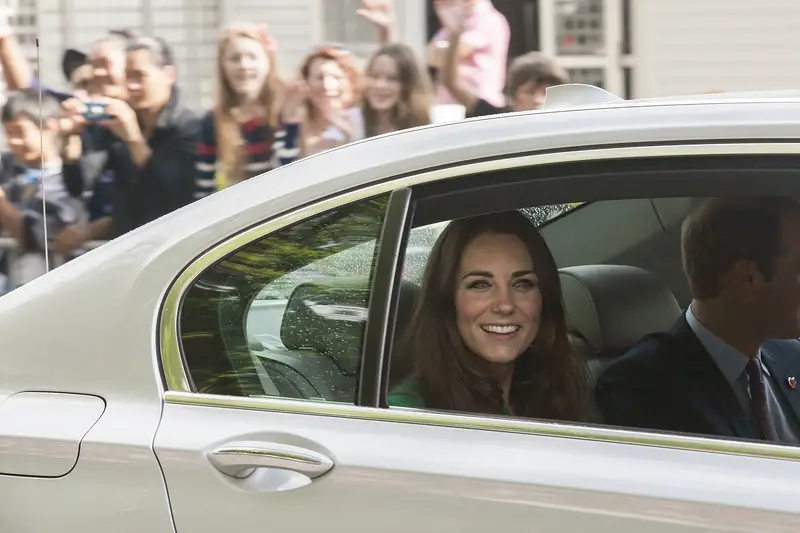
Ever notice something odd when you see photos of the British royal family riding in their fancy cars? Look closely at those pictures of Kate Middleton and Prince William heading to formal events, and you’ll spot it. They’re not wearing seat belts. That’s right—the same family that has security guards everywhere, that won’t let two heirs fly on the same plane, and that plans every detail of their safety down to the second often skips the one safety feature most of us use every single day. Before you start thinking they’re setting a terrible example, there’s actually a pretty logical explanation behind this choice. It turns out that when you’re part of one of the most recognizable families on the planet, normal rules don’t always apply.
Security concerns trump standard safety practices
The main reason royals go without seat belts boils down to one word: extraction. According to British security expert Michael Chandler, protection officers need to be able to pull royals out of vehicles as quickly as possible if there’s a threat. When someone’s trying to harm you, fumbling with a seat belt latch could mean the difference between safety and danger. Protection teams conduct risk assessments before every trip to determine whether the royals should wear seat belts or not.
Think about it like this: if someone starts shooting at the car or there’s a security breach, those extra three seconds to unbuckle could be critical. Dai Davies, the former head of royal protection at Scotland Yard who kept the family safe during the 1990s, explains that it’s all about weighing different types of risks. On ceremonial routes where roads are completely blocked off and there’s no other traffic, the chance of a car accident drops to almost zero. In those situations, the bigger concern becomes getting royals to safety if something unexpected happens. It’s a calculated decision based on what’s more likely to go wrong in that specific moment.
Short trips at slow speeds don’t require restraints
When you see photos of royals arriving at state banquets or leaving Buckingham Palace for Trooping the Colour, they’re usually traveling very short distances at a crawl. These aren’t highway speeds we’re talking about. The cars inch along cleared roads, sometimes moving slower than you could walk. In these specific situations, the risk of a serious crash is minimal. Davies points out that for events like the King’s coronation or other major ceremonies, the entire route gets shut down. No other vehicles share the road with the royal convoy.
The location and journey matter more than people realize. If there are no other cars around and the vehicle is barely moving, a traffic accident becomes virtually impossible. It’s similar to how you might not buckle up when moving your car from the street to your driveway—though obviously on a much grander scale with way more security planning involved. The key difference is that protection officers make this decision based on careful analysis, not just convenience. Every royal trip involves evaluating the specific circumstances of that particular route at that particular time.
Formal outfits can get ruined by seat belt straps
Here’s something most people don’t consider: when you’re wearing elaborate gowns, military uniforms with medals, or perfectly tailored suits worth thousands of dollars, a seat belt can wreak havoc. Michael Chandler told the Daily Mail that even something as simple as a creased shirt matters when you’re about to face hundreds of cameras. For men in formal military dress, the diagonal strap cuts across medals and sashes. For women in ball gowns or formal wear, seat belts can crush delicate fabrics and create wrinkles that show up in every photograph.
When royals are constantly getting in and out of cars for multiple stops during a single event, putting on and taking off a seat belt repeatedly becomes impractical. Each time they buckle up, they risk messing up their carefully styled outfits. Dai Davies admits that while he personally would prioritize security over appearance, he understands why this factors into the decision. After all, part of the royal job involves looking impeccable at all times. That said, Davies has a blunt take on this reasoning: when you’re facing serious danger, wrinkled clothes should be the last thing on your mind. Still, for short, controlled trips where security risks are minimal, protecting formal wear becomes a more reasonable consideration.
They actually wear seat belts more than you think
Despite all those photos showing unbuckled royals, they do wear seat belts most of the time. The images that circulate online and in newspapers typically show them arriving at events—those final moments when they’re traveling slowly on closed roads. What you don’t see are the regular car trips, the highway drives, and the everyday moments when they’re absolutely buckled up. According to security experts, when royals travel quickly through London or on motorways, they definitely wear seat belts just like everyone else.
The younger generation of royals especially makes a point of setting a good example. Prince William and Kate always buckle up when taking their kids to school. When Prince George was born, photographers caught William carefully securing the infant car seat and fastening his own seat belt before driving away from the hospital. Princess Beatrice and her family wore seat belts when driving to the official royal Christmas dinner. King Charles and Queen Camilla were spotted buckled up when he took her for a ride in his new electric Audi. The difference is that these everyday moments don’t make headlines the way formal arrivals do, so people get a skewed impression of royal seat belt habits.
The King literally can’t be prosecuted for anything
Here’s where things get really interesting from a legal standpoint. King Charles has something called sovereign immunity, which means he’s completely above the law. This isn’t a new privilege—it dates back to the Bill of Rights from 1689, which established that the monarchy can’t face legal challenges or court proceedings. A more recent law from 1947 allowed people to sue government departments but specifically kept the monarch exempt. So technically, King Charles could drive around without a seat belt all day every day, and nobody could do anything about it.
What about other royals like William, Kate, and the rest? They don’t have the same legal protection, but they’re still unlikely to face consequences. In the UK, not wearing a seat belt can get you fined up to £500 (about $660). However, when protection officers make the decision to forgo seat belts based on security assessments, other police aren’t going to challenge that call. There’s also an exemption in the Road Traffic Act for vehicles used by police, fire, and rescue services—and that includes diplomatic protection officers from the Metropolitan Police. Davies notes that he can only remember Princess Anne and Princess Diana getting in trouble with police, and both times it was for speeding rather than seat belt violations.
Private royal estates follow different rules entirely
Queen Elizabeth and Prince Philip were photographed countless times driving around without seat belts, but there’s an important detail people often miss. Most of those pictures came from their private estates like Balmoral, Sandringham, or Windsor. When you’re on your own property, different rules apply. Just like you could technically drive around your own farm without a seat belt (though you probably shouldn’t), the royals can do whatever they want on their private lands. It’s their choice, and no law enforcement is going to stop them.
Davies points out that this is similar to what regular people can do on their own property—the difference is just the scale. Royal estates span thousands of acres, so there’s plenty of space for driving around. The late Queen was famous for driving herself around her properties well into her 90s, often without a seat belt. Prince Philip did the same until his car accident near Sandringham when he was 97. While they might not have been setting the best example, they were within their rights on private property. Once they left their estates and got onto public roads, the usual rules and security considerations kicked back in.
Princess Diana’s death changed nothing about the policy
You might think that after Princess Diana died in a car crash in Paris in 1997, the royal family would have completely changed their approach to seat belts. Tragically, Diana, her boyfriend Dodi Fayed, and their driver Henri Paul all died in the crash, while bodyguard Trevor Rees-Jones survived with serious injuries. The key detail? None of them were wearing seat belts. According to David Douglas, a former senior Metropolitan Police officer who worked on the official investigation, wearing seat belts would have given them about an 80% chance of survival. They would have been badly hurt, but probably not killed.
Despite this devastating lesson, the royal family’s seat belt practices haven’t fundamentally changed. They still make the same risk-based assessments for each trip. Davies believes that if Diana had been with a royal protection officer that night, things might have ended differently. The officer would have insisted everyone buckle up and told the driver to slow down. Davies is blunt about it: paparazzi following the car didn’t kill anyone—the lack of seat belts and excessive speed did. He hopes people, including royals, would rethink skipping seat belts after Diana’s death, especially on any trip involving risk. Yet the current policy remains flexible based on specific circumstances rather than requiring seat belts at all times.
Risk assessment happens before every single trip
Nothing about royal transportation happens by accident or on a whim. Before every trip, protection officers conduct detailed risk assessments. They evaluate the route, the speed, the traffic conditions, the threat level, and numerous other factors. Based on all this information, they make a decision about whether seat belts are necessary for that specific journey. It’s not a blanket yes or no—it changes depending on the circumstances. A trip to a state dinner at Buckingham Palace gets evaluated differently than a drive on the highway to Scotland.
Chandler explains that there’s a risk-based approach to every decision. The outcome of each assessment determines what extra precautions need to happen. Sometimes that means seat belts are essential. Other times, quick extraction ability matters more. Davies stresses that this should always be about security first, with appearance and convenience coming last. When there’s any real danger—whether from traffic, threats, or other factors—seat belts should be mandatory. It’s only in those carefully controlled situations with minimal risk where protection officers might decide that unbuckled royals make more sense from a security standpoint. The key is that trained professionals make these calls, not the royals themselves based on comfort or convenience.
Regular people should definitely not copy this behavior
Here’s the most important thing to understand: just because royals sometimes skip seat belts doesn’t mean you should. They have protection officers, cleared routes, and specific security situations that justify their choices. You don’t have any of that. Davies is clear that wearing a seat belt is just common sense for everyone else. Every car trip you take involves other vehicles, unpredictable traffic, and risks that royals on ceremonial routes don’t face. The statistics are overwhelming—seat belts save lives in accidents, and there’s no good reason for regular people to go without them.
Even for royals, Davies believes seat belts should be the default choice in most situations. It’s only those rare, controlled circumstances where going without them makes any sense at all. For the rest of us driving on normal roads with normal traffic, there’s simply no justification. Your shirt might get a little wrinkled, but that’s a pretty small price to pay for staying alive in a crash. The younger royals seem to understand this better than previous generations, making a point to buckle up when cameras are watching. Davies puts it perfectly: when you’re facing judgment day, nobody’s going to care about your outfit—they’ll wish you had worn your seat belt. That’s advice worth following, whether you’re royal or not.
The royal family’s seat belt habits might seem strange at first, but they make sense within the unique context of their lives. Between security concerns, ceremonial duties, and carefully controlled environments, their situation differs completely from what regular people experience. Still, it’s worth noting that they buckle up far more often than sensational photos suggest. The lesson here isn’t that seat belts don’t matter—it’s that extremely specific circumstances sometimes call for different approaches. For everyone else, the answer is simple: wear your seat belt every single time.

