

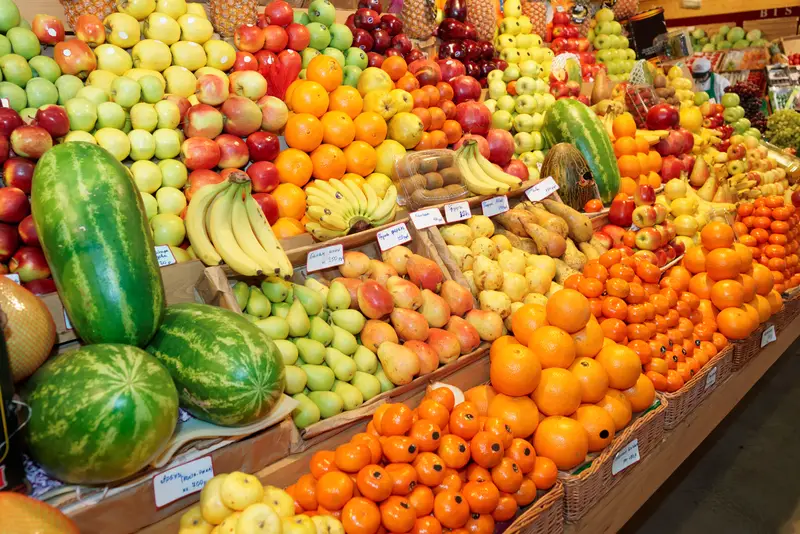
We all grew up hearing the same thing: eat more fruit. It’s nature’s candy, they said. It’s good for you, they said. And look — fruit IS good for you. Nobody serious is telling you to stop eating it. But there’s a wild disconnect between what most Americans think about fruit and what’s actually happening inside some of their favorite picks, sugar-wise. Because one of the most beloved fruits on the planet — one you can grab at literally any grocery store in America — contains nearly double the sugar of a Hershey’s chocolate bar.
That’s not a typo. And no, it’s not some exotic thing you’ve never heard of. It’s sitting right there in the produce section at Walmart.
The Mango Problem Nobody Talks About
A single medium-sized mango contains around 46 grams of sugar. Let that number sit in your brain for a second. Now consider that a standard 1.55-ounce Hershey’s milk chocolate bar has about 25 grams of sugar. That means your innocent-looking mango — the one you sliced up for breakfast because you were “being healthy” — has roughly 84% more sugar than the candy bar you’d feel guilty about eating at a movie theater.
To put it another way: you’d need to eat almost two Hershey’s bars to match the sugar in one mango. The Cleveland Clinic even compared a single mango to eating 50 pieces of candy corn. Fifty. That’s like half a bag during Halloween.
Now, before you swear off mangoes forever and start a petition: the sugar in a mango and the sugar in a candy bar are not processed by your body in the same way. Fruit comes with fiber, vitamins, water content, and other compounds that slow down how your body absorbs that sugar. A candy bar dumps refined sugar into your bloodstream like a firehose. A mango is more like a garden sprinkler. Same water, very different delivery. But the raw numbers are still startling, and most people have absolutely no idea.
Tropical Fruits Are the Sneakiest Sugar Bombs
Mangoes aren’t alone in this. Tropical fruits in general tend to be much higher in sugar than their temperate-climate cousins, and the reasons are actually pretty interesting. Tropical plants evolved in environments with year-round warmth and intense sunlight, which means they photosynthesize like crazy and pack their fruits with more sugar to attract animals that spread their seeds. That sweetness is a survival strategy — and it works brilliantly on humans too.
Bananas, for example, have about 14 grams of sugar each. Pineapple rings in at around 16 grams per cup. A cup of lychees has roughly 29 grams. And if you’ve ever had jackfruit — which has been trending as a meat substitute — a cup of it contains about 31 grams of sugar. These are all fruits with surprisingly high sugar content that rarely get the scrutiny of, say, a can of Coke (which has 39 grams, for reference).
Contrast that with berries. A full cup of strawberries has only about 7 grams of sugar. A cup of raspberries? Around 5 grams. Blackberries come in at roughly 7 grams. You could eat three cups of strawberries and still come in under the sugar content of a single mango. That’s a massive difference that changes the math on your smoothie bowl.
The Blueberry Comparison That Broke the Internet
There’s been a viral post circulating on social media that compared the sugar content of blueberries to a Mars bar — and found that the blueberries actually had more sugar. People lost their minds. But here’s the catch: portion size was doing all the heavy lifting in that comparison. When you compare a large serving of blueberries to a single candy bar, yes, the numbers can flip. But nobody’s eating a massive bowl of blueberries in one sitting the way they’d eat a candy bar.
Still, the broader point stands. We tend to think of fruit as a freebie — something you can eat unlimited amounts of without consequence. And for most people eating a reasonable amount, that’s mostly fine. But if you’re someone who throws two bananas, a mango, a handful of dates, and some pineapple into a blender every morning, you might be drinking something with 80-plus grams of sugar before 9 AM. That’s more than a 20-ounce bottle of Mountain Dew.
Dried Fruit Is Where Things Get Really Weird
If fresh fruit can surprise you, dried fruit will absolutely floor you. When you remove the water from fruit, you concentrate the sugar into a much smaller, denser package. And then people eat way more of it because a handful of dried mango rings doesn’t feel like much food.
Here’s a stat that should make you do a double-take: dried cranberries contain 50% more sugar than the same weight of gummy bears. Read that again. Craisins — the thing people sprinkle on salads to feel virtuous — have more sugar per gram than actual candy. A quarter-cup serving of dried cranberries has about 29 grams of sugar. A similar serving of Haribo gummy bears has around 18-20 grams.
Dried dates are even more extreme. A single Medjool date has about 16 grams of sugar. Eat four of them — which is really easy to do, because they’re delicious — and you’ve consumed 64 grams of sugar. That’s more than a can of Pepsi and a fun-size Snickers combined. And yet dates are marketed as a “healthy sweetener” in protein balls and energy bars all over Instagram.
Dried figs, raisins, dried pineapple — they’re all concentrated sugar delivery systems. The ones from Trader Joe’s with the yogurt coating? Don’t even get me started.
Why Your Smoothie Might Be a Milkshake in Disguise
Americans spend billions on smoothies every year, and the smoothie industry has done a brilliant job positioning itself as the healthy alternative to fast food. But a lot of what’s sold at places like Jamba Juice or Smoothie King is nutritionally closer to dessert than anyone wants to admit.
A medium “Power Plus” smoothie from Smoothie King can contain over 80 grams of sugar. A large Aloha Pineapple smoothie from Jamba clocks in around 67 grams. For comparison, a McDonald’s McFlurry with M&M’s has about 64 grams of sugar. So you’re standing in line at the smoothie shop thinking you’re making a better choice than the drive-through, and you might actually be consuming more sugar.
The sneaky part is that much of this sugar comes from real fruit — mango, banana, pineapple — plus fruit juice concentrates. So on the label, it looks clean. No high-fructose corn syrup, no artificial sweeteners. Just fruit. But your pancreas doesn’t care about marketing. Sugar is sugar once it hits your bloodstream, and the nutritional nuance matters more than most people realize.
Grapes Are Basically Nature’s Skittles
Here’s one that hits close to home for anyone who sits down with a bowl of grapes during a Netflix binge. A cup of grapes has over 20 grams of sugar. That’s roughly the same as eating 8 Oreo cookies. And nobody eats just one cup of grapes. When was the last time you measured out a single serving of grapes? Never. You eat the whole bag while watching three episodes of something on Hulu, and suddenly you’ve consumed 60 or 70 grams of sugar while thinking you chose the responsible snack.
Cherries are another offender that flies under the radar. A cup of sweet cherries has about 18 grams of sugar. Pomegranate seeds — often tossed on açaí bowls and labeled as a superfood — run about 24 grams per cup. Even apples, the most iconic “healthy” food in American culture, average around 19 grams of sugar each. That’s more than a serving of Frosted Flakes cereal, which has about 13 grams.
So Should You Stop Eating Fruit?
Absolutely not. That’s the wrong takeaway, and anyone who tells you to cut out fruit entirely is probably trying to sell you something. Whole fruit gives you fiber, vitamins, minerals, antioxidants, and water in a way that candy and soda simply don’t. The fiber alone changes how your body processes the sugar — it slows absorption, keeps your blood sugar more stable, and keeps you feeling full. You will never see a doctor blame someone’s health problems on eating too many strawberries.
But the point here isn’t that fruit is bad. The point is that the mental shortcut of “fruit = automatically harmless” is outdated and incomplete. Portion size matters. Context matters. If you’re diabetic or pre-diabetic, the difference between a cup of raspberries (5 grams of sugar) and a mango (46 grams) is huge. If you’re trying to reduce sugar intake, swapping your tropical fruit smoothie for a handful of berries could cut your daily sugar consumption by a third or more.
The real lesson here is that sugar content in food is wildly counterintuitive. A mango beats a Hershey’s bar. Dried cranberries beat gummy bears. A smoothie from the “health” shop beats a McFlurry. Once you start looking at the actual numbers, the things we’ve labeled “good” and “bad” start to blur in ways that are genuinely surprising. And that’s worth knowing, whether you change your habits or not.

