

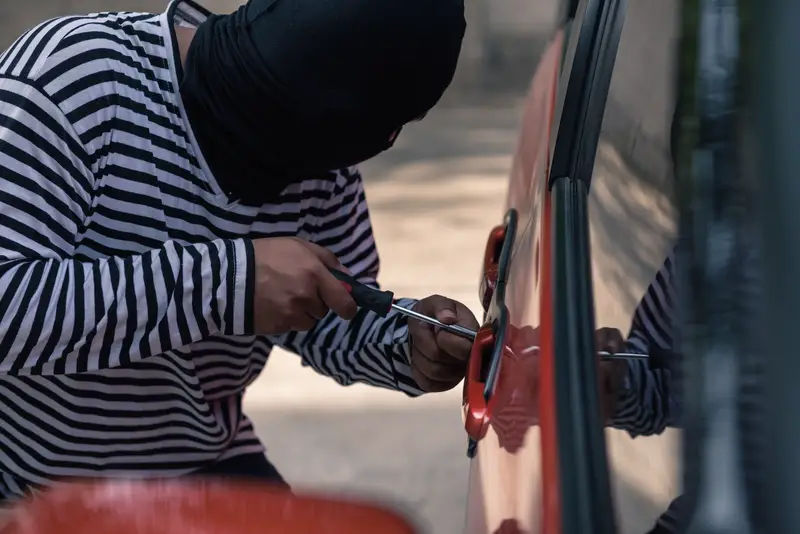
Here is a story that will make you want to check your driveway right now. A guy named Ken Petrikat in Wauwatosa, Wisconsin woke up one morning, walked outside, and his car was just gone. No broken glass. No shattered lock. Nothing. A neighbor’s Ring camera later showed the car quietly rolling away around midnight. What makes this worse? It happened to him twice. The second time, his car came back wrecked in a crash.
Car theft used to mean a busted window and some kid hot-wiring an engine. That world is disappearing fast. Today’s thieves carry small gadgets, some no bigger than a TV remote, that let them drive off in your car in under a minute. Here are the surprising, slightly terrifying facts about the tools quietly emptying driveways across America.
The whole setup costs about as much as dinner for two
You would think a device capable of stealing a $60,000 truck would be locked away somewhere shady. Nope. The main tool is a key programmer that plugs into your car’s OBD-II port, which is the same little port your mechanic uses for diagnostics. It sits in the exact same spot on almost every car ever made: under the dashboard, right around your left knee.
The kicker is the price. These programmers run anywhere from $30 to $100, and an Austin locksmith flat-out admitted you can buy this stuff on Amazon or eBay with a few clicks. As he told Austin police reporters, the technology is just out there now, accessible to anyone. A thief breaks a window, plugs in the device, and it talks directly to your car’s computer to clone your key fob or program a fresh blank key. The whole thing takes one to three minutes. Your alarm barely matters, because by the time it means anything, the car is already down the block.
Your keys can be stolen straight through your front wall
This is the part that sounds made up, but it is very real. Some thieves do not even bother breaking a window. Instead they use something called a relay attack, and all they need is two cheap radio amplifiers and your key fob sitting on a table near the door.
Here is how it works. Your key fob is constantly whispering a faint radio signal, even while it sits in your purse or on the kitchen counter. One thief stands near your house holding a device that grabs that signal. A second thief stands by your car holding a device that repeats it. Your car thinks the real key is right there in someone’s hand, so it unlocks and starts. No sound, no glass, no alarm.
The scary math comes from Germany’s largest auto club, ADAC, which has tested more than 800 keyless cars against this trick. According to their ongoing testing, only about 15% were properly protected. That means roughly 85% could be opened and driven off with cheap signal gear. And here is the wild detail: this is not hacking or code-breaking. The relay does not crack your encryption at all. It just borrows your real, live signal and stretches it farther than the carmaker ever intended. Rolling codes were built to confirm who the key is, not how far away it is. That is the loophole.
It happens in broad daylight, not just at 3 a.m.
We picture car theft as a nighttime thing, a shadowy figure sneaking around under a streetlight. The data says otherwise. A lieutenant with the Hennepin County Sheriff’s Office Auto Theft Task Force in Minnesota put it plainly: they are seeing the same number of cars stolen during the day as at night.
Minneapolis actually had two straight years of falling car thefts, and then 2026 flipped the trend right back up. Police pointed a finger at these key-programming devices. In just one four-week stretch, 423 vehicles were stolen in the city. Reports of cars taken without keys jumped 56% for non-Kia, non-Hyundai models compared to the year before. That Minneapolis surge is not some fluke in one bad neighborhood. It is a citywide bounce driven partly by technology that used to belong only to locksmiths.
Your regular car is a target too, not just the fancy ones
People love to assume this only hits Lamborghinis and loaded luxury SUVs. Automotive expert Lauren Fix shut that idea down hard. She warned that the problem now reaches ordinary cars parked in ordinary driveways, garages, and city streets. Her reasoning made a lot of sense: the more the car industry pushes digital convenience, the more openings it creates. Keyless entry, remote start, app-based controls, phones acting as keys. Every shiny new feature is another door a criminal might slip through.
That said, some models do get hit more than others. The most targeted list includes GM trucks and muscle cars like the Silverado, Sierra, Camaro, and Corvette, plus Toyota and Lexus SUVs like the 4Runner, Highlander, GX, and LX, along with a good number of BMWs. But the underlying weakness is simple. As one theft-prevention guide pointed out, any vehicle with a standard OBD2 port is fair game. That is basically every car on the road.
The victims all say the same eerie thing
What gets me is how similar every story sounds. Steve Traub, who lives near the Petrikats in Wisconsin, had owned his Lexus for just 90 days before it vanished from his driveway. He was out of town, and his keys were sitting safely inside his house, on the back side of an interior wall. That wall did nothing. He was one of six people on his single street who got targeted.
In the Petrikat case, police figured out the thieves connected to a fob tucked inside a purse near the front door. That is the pattern, over and over. The fob sits close to an exterior wall, a window, or the entryway. The signal leaks out just far enough. According to the Wauwatosa reports, the location of your keys inside your own home suddenly matters a whole lot more than anyone realized.
These are organized crews, not bored teenagers
Some of these thefts are kids copying tricks they saw online, sure. A Twin Cities locksmith said he has watched teen thieves pick up the exact same technology he uses for his job. But a lot of this is running on a much bigger scale.
A federal indictment out of Washington, D.C. charged six people tied to an international car theft ring. The group was accused of stealing more than 100 vehicles in D.C. alone, plus dozens more across Maryland. As the federal case shows, these crews are organized, fast, and efficient. This is not smash-and-grab anymore. It is closer to a business, run by people who know exactly which tool to plug in and exactly how many seconds it takes.
The old-school steering wheel club is having a comeback
Here is the good news, and it is genuinely a little funny. The best defenses against this high-tech theft are mostly cheap and low-tech. Police keep recommending the same things, and they work because they add friction a thief cannot solve with a gadget.
First, that fob signal. Grab a Faraday pouch, which is a little signal-blocking sleeve that stops your key from broadcasting at all. Toss your keys in it when you get home. Even simpler, keep your fob deep inside your house, far from doors and windows, so the signal cannot reach a relay device outside. Some fobs even have a motion-sensing sleep mode you can turn on so they go quiet when they sit still. Those steps stop the through-the-wall attack cold, and a breakdown of relay theft lists them as the front line of defense.
For the plug-in method, there is an OBD port lock. It is a physical cover that blocks access to that port under your dash. One popular pick, the VTT OBD-Lock, uses rotating proprietary screw heads that get changed every 200 units, which makes it a pain to defeat. A key-cylinder option, the bbfly-K01, offers more than 10,000 key variations and installs without tools. On top of that, a Connecticut sergeant who runs an auto theft task force recommended the classics: a steering wheel club and a hidden kill switch. In his experience, layering these makes your car more trouble than it is worth, and thieves move on to easier targets.
One more layer worth mentioning: a hidden aftermarket GPS tracker. It will not stop the theft, but it dramatically improves your odds of getting the car back before it ends up in pieces. Between a signal pouch, a port lock, and a big ugly club on your wheel, you turn a one-minute job into a headache no thief wants. And in a world where the tools keep getting smaller and cheaper, being the harder car on the street is exactly where you want to be.

