

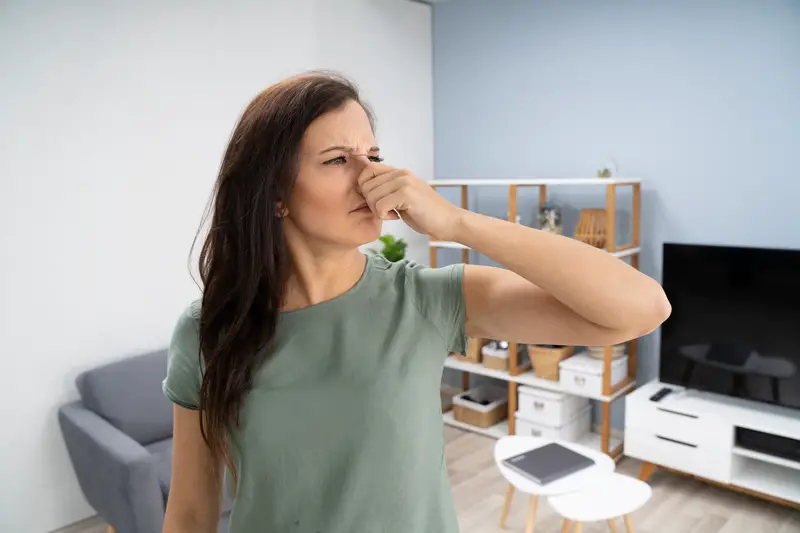
Your nose is smarter than you think. Way smarter. It can pick up on threats that your eyes and ears completely miss — threats that could kill you, burn your house down, or slowly poison your family while you sleep. The problem is that most of us have no idea what we’re actually smelling when something seems “off” inside our homes. We light a candle, crack a window, and move on with our lives.
That’s a mistake. Some smells are your home screaming for help, and the right response isn’t to Google “weird smell in kitchen.” It’s to grab your kids, grab the dog, and get out the front door.
Here are the specific smells that mean something is seriously wrong — and what each one is actually trying to tell you.
Rotten Eggs: The One Everyone Should Know
If you catch a whiff of rotten eggs in your house and you haven’t actually cooked any eggs, stop what you’re doing. Don’t flip a light switch. Don’t plug in your phone. Don’t light a match. Just leave.
That rotten egg smell is almost certainly a natural gas leak. Here’s the thing most people don’t realize: natural gas itself is completely odorless. You’d never know it was filling your house. So gas companies add a chemical called mercaptan specifically to make the gas stink like sulfur and rotten eggs. It’s an intentional safety feature — one that has prevented countless explosions since it became standard practice.
Frank Lesh, executive director of the American Society of Home Inspectors, has said it plainly: leave the house immediately and call the gas company from your cell phone or a neighbor’s phone — not from inside your home. Even a tiny electrical spark from a phone charging or a light switch could ignite the gas.
Other signs that back up a gas leak include a hissing sound near your stove, furnace, or water heater. You might see bubbles rising through standing water outside near your gas meter. Dead patches of grass or plants above an underground gas line are another giveaway. And if people in the house are getting headaches, dizziness, or nausea alongside that smell, the situation is already serious.
Even if the smell is faint — almost like you’re imagining it — go. A mild smell doesn’t mean a mild leak. It means the gas hasn’t concentrated yet. Give it time and you’ve got yourself a bomb.
Fish When Nobody’s Cooking Fish
This one catches people completely off guard. You walk into a room and it smells like seafood. Nobody cooked fish. There’s no fish in the fridge. You check the trash — nothing. So where’s the smell coming from?
Your walls. Specifically, the electrical wiring behind them.
When wires, outlets, or other electrical components overheat, the plastic insulation around them starts to melt. Before it reaches full-on burning, that melting plastic releases chemicals that a lot of people describe as smelling fishy. It’s one of the strangest warning signs in any home, and most people have no clue about it.
According to the National Fire Protection Association, electrical fires account for an estimated 51,000 home fires every single year. Those fires kill roughly 470 people and cause more than $750 million in property damage. Electrical malfunction is consistently one of the top three causes of house fires in America.
The fish smell is actually the early warning — the stage before actual flames. If you catch it, you’ve got a window to act. Check your outlets and switches. If any feel hot to the touch, look charred or discolored, or if you hear buzzing or crackling sounds, shut off the breaker for that circuit immediately and call an electrician. Don’t just unplug something and call it a day.
Older homes are especially vulnerable. If your house still has its original wiring from the 1960s or 70s, the insulation has been degrading for decades. Annual electrical inspections aren’t just a nice idea — they’re the difference between catching a problem and losing your home.
The Smell of Nothing at All: Why Carbon Monoxide Is the Real Nightmare
Here’s what makes carbon monoxide so terrifying: you can’t smell it. At all. It’s colorless, odorless, and tasteless. Your nose — that incredible threat-detection system — is completely useless against it.
Carbon monoxide is a byproduct of incomplete combustion. That means any fuel-burning appliance in your home can produce it: your furnace, gas stove, water heater, fireplace, space heater, even a car idling in an attached garage. When these appliances malfunction or a space is poorly ventilated, CO can build up fast. It causes roughly 430 accidental deaths and 50,000 emergency room visits in the U.S. each year.
Because you can’t smell it, the only reliable defense is a working carbon monoxide detector. And yet here’s a stat that should bother you: most CO detectors need to be replaced every five to seven years. How many people in your life do you think have actually checked the manufacture date on theirs? If the answer is none, you’re probably right.
One indirect smell to watch for: a strong chemical odor coming from your furnace could indicate a cracked heat exchanger — the component that keeps combustion gases separated from the air your family breathes. A crack in the heat exchanger can push carbon monoxide fumes straight into your home’s air circulation. If you smell something chemical near your furnace and nobody’s been using paint or cleaning products, get out and have it inspected.
Another huge red flag: if everyone in the house starts feeling the same symptoms at the same time — headaches, dizziness, nausea, confusion — suspect CO immediately. Get out and call 911.
Sewage Smell: More Dangerous Than You’d Think
Most people assume a sewer smell is just gross. Unpleasant but harmless. Wrong.
Sewer gas is a cocktail of compounds including hydrogen sulfide, ammonia, methane, and carbon dioxide. Hydrogen sulfide — the stuff that makes it smell like rotten eggs — is toxic to the body’s oxygen systems, according to published research. At low concentrations, it causes headaches, dizziness, nausea, and fatigue. At high concentrations, it can damage organs or kill.
Then there’s the methane. Methane is extremely flammable. Combine that with the flammability of ammonia, and high levels of sewer gas in an enclosed space become a genuine fire and explosion hazard. This isn’t theoretical — it’s chemistry.
The most common cause is stupidly simple: a dried-out P-trap. That U-shaped pipe under your sink or in your floor drain holds a small amount of water that acts as a seal against sewer gases. If you’ve got a guest bathroom nobody uses, a basement floor drain, or a shower that sits idle for months, that water evaporates. And now there’s nothing between your living room and the sewer line underneath your house.
The fix is just as simple: pour a cup of water down the drain. For extra protection, add a teaspoon of vegetable oil on top — it slows evaporation. But if the smell persists after that, you could have cracked drain pipes or vent pipes, which require a plumber with a smoke machine to diagnose.
Something Sweet Could Mean Something Toxic
A sweet, almost syrupy smell in your house sounds pleasant. It’s not. It could mean you have a coolant leak from your refrigerator, air conditioner, or heat pump.
Refrigerant chemicals can be toxic if inhaled or ingested. A faint sweetness near your fridge might be a slow, low-urgency leak. But a strong, syrupy odor near your central air unit? That’s high-urgency. If you suspect a coolant leak, turn off the appliance at the breaker box. Don’t touch or breathe in any visible coolant. And here’s one people never think about: throw away any food or drinks that may have been exposed to the leaking chemicals.
Burning Plastic Behind Your Walls
An electrical fire doesn’t always announce itself with a fishy smell. Sometimes it skips straight to the acrid, chemical stench of burning plastic. If you smell that, a fire may have already started — possibly inside a wall, above a ceiling, or behind an outlet where you can’t see it.
When plastic insulation burns, it releases ketones and aldehyde gases into the air. These are harmful to breathe, even in small amounts. If you smell burning plastic and can’t immediately identify the source — like a toaster that got left on — shut off your breakers, get everyone out, and call 911. Electrical fires can go from invisible to fully engulfed in practically no time.
Some warning signs that an electrical fire is brewing before you ever smell anything: flickering lights, circuit breakers that keep tripping, outlets that feel warm, and small sparks when you plug something in. Any one of these is worth a call to an electrician. All of them together? That’s your house waving a red flag.
Cleaning Products That Turn Into Poison Gas
Here’s one that happens in American homes all the time, usually by accident: mixing bleach with ammonia-based cleaners (like Windex) creates chloramine gas. Mixing bleach with an acid — like many toilet bowl cleaners — creates chlorine gas. Both are toxic, and both can cause serious respiratory damage.
Symptoms include burning eyes, coughing, difficulty breathing, headaches, and dizziness. If you accidentally mix cleaning products and notice a strong chemical smell or start having trouble breathing, get out of the room, open windows behind you, and get fresh air immediately.
Your nose exists to protect you. When it picks up something wrong, the worst thing you can do is ignore it. A $2 cup of water down a dry drain, a $30 CO detector from Home Depot, or a 10-second walk out the front door — these are small prices to pay. Trust the smell. Then get out.

