

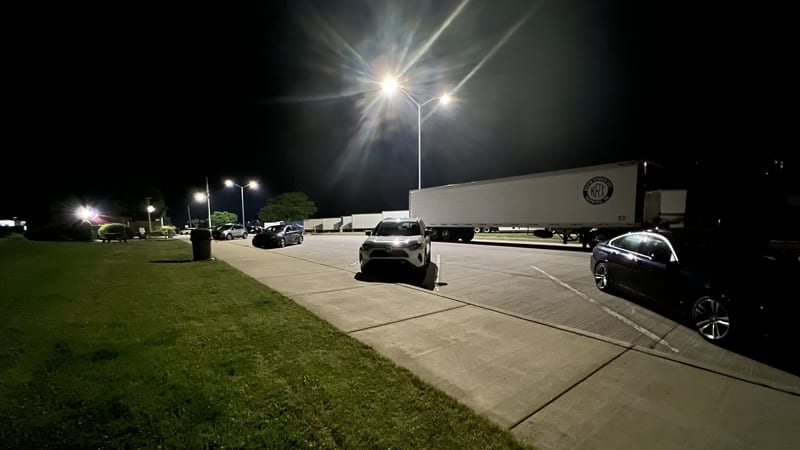
It’s 1:40 a.m. on an interstate you don’t know well, your eyes are stinging, and the blue sign with the little picnic table icon shows up right when you need it. Free parking. Bathrooms. A vending machine. Maybe a map under scratched glass. Everything about it says stop here.
That sign is the one safety experts tell drivers to pass. Highway rest areas are at their worst once the sun goes down, and the standard advice is blunt: if the lot isn’t bright and busy, keep driving and find a gas station, truck stop or fast food place instead. Some versions of the advice put a clock on it. Nothing after midnight.
Midnight Is an Actual Line, Not a Figure of Speech
One security firm’s safety guidance for rest areas lists avoiding them entirely after 12 midnight as the first rule, ahead of parking in a lit spot or locking your doors. The reasoning is simple math on human behavior: the later the hour, the fewer witnesses, and the more tired and distracted the people who do pull in.
Truckers Won’t Walk To That Bathroom Alone
Long-haul drivers live at rest areas. They sleep in them, eat in them, know which ones have working showers. So it says something that, by security consultants’ account, many truckers will only use rest area restrooms if they have other truckers walking in with them.
Think about who else is in that building. A family on vacation, going in one at a time while someone waits in the car with the kids. A solo driver with a wallet, a phone and car keys, moving fast because they want to get back on the road. Police describe the problem as people walking in with their guard all the way down, focused on the restroom and the coffee machine and nothing else. That’s the opening, and it’s why the advice is always to walk in in pairs.
There Are Only About 1,800 Of Them, And The Crime Numbers Stay Buried
For all the miles of interstate in this country, there are, by one count, slightly over 1,800 highway rest stops in the United States. That’s it. Every road trip in America funnels through the same small number of concrete buildings.
And almost nobody sees what happens inside them. The FBI’s incident reporting system does log rest areas as a crime location, but coverage is patchy and the numbers rarely leave the database. What most people hear about is scattered across state agencies and individual police reports. When you hear that rest areas are safe, understand that nobody is putting the scoreboard in front of you.
Sleeping In Your Car There Is Banned In Some States
The free overnight nap at a rest area is one of those road trip traditions that quietly stopped being allowed. Some states, Virginia among them, ban overnight parking at rest areas outright, and most others cap how long you can stay.
If you’re tired enough to need sleep, the advice is a motel or a campground, not a reclined seat in a dark lot with strangers coming and going all night. It costs money. It is also the only version of the night where you’re not unconscious in a parked car on a stretch of highway with no address.
The Crimes Range From Petty To Fatal
At the low end, it’s a wallet lifted out of a purse hanging on the hook inside a restroom stall. The hook is at head height on the door, your bag is unattended for ten seconds, and it’s gone over the top. From there it climbs through car break-ins, strong-armed robbery and muggings, carjacking and homicide.
The specific cases are stranger than the categories. In July 2022, thieves took jewelry worth millions from a Brink’s truck parked at a truck stop in Lebec, California, while the driver slept, and nobody was hurt. In 2020, a man was killed in a carjacking at a rest stop along I-26 in North Charleston, South Carolina. In May 2022, a man was fatally shot at a rest stop in Bonneville County, Idaho. In 2021 the Washington State Department of Transportation closed several I-5 rest stops, citing staff shortages along with vandalism, trash and threats to workers.
Truckers Are The Ones Spotting Traffickers
Human trafficking moves along the same interstates everyone else uses, and rest stops are where it surfaces. Of the victims identified through truckers’ calls to the national trafficking hotline, more than a quarter were minors. Trucking companies in San Antonio have put their drivers through Truckers Against Trafficking training to help spot traffickers, because drivers are the ones parked there for hours noticing which vehicles don’t fit.
That detail reframes the whole place. The guy in the cab who won’t walk to the bathroom alone is also the person most likely to make the call that gets someone out.
The Gas Station You Stop At Instead Has Uglier Numbers
Here’s the twist in all this. FBI National Incident-Based Reporting System data for 2020, from agencies covering about half the country, counted 675,715 violent crimes across all location types. Rest areas accounted for 279 of them. Convenience stores accounted for 20,108, which made them the 4th most common location for violent crime in the country. Gas stations logged 11,795 and ranked 7th. Parking lots and garages recorded 45,107 incidents, 3rd overall, and highways, alleys, streets and sidewalks together accounted for 130,331, second only to homes.
Of 137,556 robberies in that data, 13,721 happened at convenience stores and 7,006 at gas stations. There were 157 homicides at convenience stores and 119 at gas stations. Most of these places are open around the clock with one employee working overnight, which is exactly the setup police describe when they talk about loitering, robberies and carjackings.
So the rest stop warning isn’t really about rest stops. It’s about isolation, darkness and being the only person in the lot. A busy, bright, staffed travel plaza off an exit beats an empty rest area every time. A dim gas station on an empty stretch, with the clerk out of sight and no other cars at the pumps, is the same trap with a different roof.
Park Away From The Big Rigs, Not Next To Them
Most people pull in and park wherever’s closest to the door. The better move is a spot that’s lit and visible from the main road or the rest stop building, and not tucked between large trucks or RVs where nobody can see your car or you. The edges are where the trouble lives: picnic tables, trails, the woods at the back of the property. Those are the parts of a rest area to skip entirely at night.
Lighting isn’t just a comfort thing, either. If a rest stop is poorly lit and someone gets attacked there, the owner or operator, including a state transportation department, can be on the hook for failing to provide adequate lighting. That’s a claim called negligent security, and against a state agency it is much harder to win than against a business. Frequent police patrols or a permanent security officer at a rest area usually means crime there got bad enough to require it, which is both a warning and a reason to feel better about stopping.
Some Towns Where Locals Say Don’t Even Stop For Gas
A handful of small American towns sit right on common highway routes and have reputations with the people who live there. Opelousas, Louisiana has a population under 17,000 and sits where US-190 meets I-49, on a common route toward Baton Rouge and New Orleans, and it ranks among the most dangerous small cities in the country. West Memphis, Arkansas carries spillover from across the bridge, and locals flag the gas stations near the interstate. Altus, Oklahoma, around 18,000 people, has persistent violent crime and drug activity. Bessemer, Alabama, just outside Birmingham, often tops the state’s violent crime rankings. Selma, Alabama sits on US-80, and the advice there from people who live nearby is to drive through without stopping at all.
Cities have the same split. In 2024 FBI crime data, Memphis posted a violent crime rate of 2,501 per 100,000 residents, the highest of any U.S. city of 100,000 or more with FBI data. Detroit recorded 203 murders. St. Louis had 150 murders and a murder rate of 54.1 per 100,000. Birmingham’s murder rate reached 58.8 per 100,000. The useful part for a traveler isn’t the ranking, it’s the pattern inside it: risk in these places varies block by block and hour by hour, and isolated parking areas and quiet transit stops come up over and over.
The Walk Back To The Car Is The Dangerous Part
Police keep flagging the same 90 seconds: the stretch between a building’s door and a car door. Have your keys in your hand before you step outside, not after you’re standing next to the vehicle digging through a bag. Look around the car and underneath it as you approach, and glance into the back seat before you get in. Parking garages make that worse with blind corners, limited exits and poor sightlines, which is why they show up on every list of places to be careful after dark.
Headphones cancel the one sense that works in the dark. With both earbuds in you won’t hear a car rolling up behind you, a bike, footsteps or an alarm. If you think you’re being followed on foot, the standard advice is not to head home but to move toward somewhere staffed and lit: a hotel lobby, a hospital, a restaurant, a police or fire station.
My Take After Reading All Of This
I’ll still use a rest area at two in the afternoon without a second thought. After midnight, the blue sign gets passed. The thing that makes a rest stop risky at 1 a.m. is not the building, it’s that you are the only person in a dark lot on a road where nobody knows you’re there, and that same condition shows up at a half-empty gas station or the back row of a parking garage.
Pick the exit with lights, people and someone working behind a counter. Lock the car even for the two minutes you’re inside. Go in with whoever you’re traveling with. And if a place feels wrong the second you roll in, the cheapest decision on the entire trip is pulling back out and driving another ten miles.

