

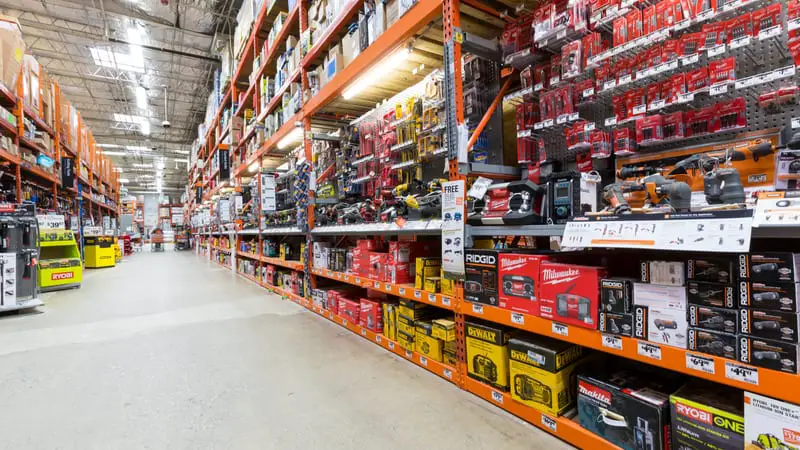
At 5:30 in the morning, in a parking lot in Queens, a crew met almost every day to decide which Home Depot they were hitting. They had already done the homework the night before, checking the chain’s own website and app to see which stores had what they wanted in stock. Over 13 months, prosecutors say, they walked out of 128 stores across nine states with more than $2.2 million in merchandise. Most of it was tools and building gear. Tools are the one thing Home Depot has never figured out how to keep on the shelf.
A Van, Two Earbuds And A 96-Gallon Trash Bin
Queens District Attorney Melinda Katz charged 13 people in a 780-count indictment in December 2025, covering grand larceny, conspiracy and criminal possession of stolen property. Prosecutors say the crew was led by Armando Diaz of Flushing, New York, and operated between August 14, 2024, and September 11, 2025.
The method was closer to a work shift than a smash-and-grab. Diaz and seven others rode in his van with a second lookout vehicle, according to prosecutors. Three or four members would walk in separately and stroll the aisles like regular shoppers while Diaz talked to them through their earbuds, telling them what to take, how to take it, and whether anyone was watching. Merchandise went into a 96-gallon trash bin or a cart, sometimes hidden under a big sheet of drywall or plywood while another member pulled an employee away. Another member, a woman, sat in the lot watching for police.
The daily take ranged from about $1,800 to nearly $35,000. “The defendants took breaks for lunch and dinner, sometimes hitting the same Home Depot up to four times in one day,” Katz said. “The stolen items were then resold to consumers, through a Brooklyn storefront or on Facebook Marketplace.”
The targeted stores were in New York, New Jersey, Connecticut, Pennsylvania, Massachusetts, Rhode Island, New Hampshire, Delaware and Maryland. Insulation kits, buckets of reflective roof coating, power tools, air conditioners and smoke and carbon monoxide detectors were the most common items taken. Investigators found stolen goods stashed in three homes, 14 storage units and eight vehicles. Eleven suspects were arrested, one was still being sought, and another was set to be arraigned later. They face up to 25 years in prison if convicted.
Why Thieves Want The Drill And Not The Deck Chairs
Power tools are the most commonly stolen item in Home Depot stores, according to the company, and the reason is resale value. A cordless drill holds nearly all of its worth on the secondhand market, which makes it close to currency with a logo on it. Scott Glenn, Home Depot’s vice president of asset protection, has laid out the rest of the shopping list: copper fittings, electrical wire, outdoor power equipment and smart home gear like light switches.
Organized retail crime is almost never about someone taking something to use it. The product gets stolen on order. Fences tell boosters exactly which items they want, then move the goods to regular customers who have no idea what they are buying. That is the difference between a person pocketing one item and a crew working 128 stores on a schedule.
The Leaf Blower That Came Back Empty
Not every scheme requires a van and a lookout. A call to Murrieta police in Southern California about a routine shoplifting at a Home Depot turned into something much larger when officers looked at what the man had actually done: he bought a leaf blower, carried it to his car, pulled the rechargeable battery out of it, and brought the empty tool back for a refund.
Investigators say he ran the same play over and over at Home Depot and Lowe’s locations in multiple states, keeping the batteries and handing back the shells. Murrieta police estimate the losses tied to the operation could reach roughly $350,000 in batteries nationwide. No cage stops that. The thief walks in the front door, pays at the register, and uses the return desk as the exit.
Home Depot Promised To Brick Stolen Tools Back In 2019
There was supposed to be a technological fix. Home Depot began announcing plans for power tool activation technology in 2019, the idea being that a tool would not work at all unless it was turned on at checkout. Lowe’s unveiled its own version, called Project Unlock, in late 2022, built around RFID chips and what it described as a novel use of blockchain. Lowe’s said the point was to activate a powered product after a legitimate purchase, making a stolen tool “inoperable and virtually worthless.”
Home Depot never released final details of its plan, and years later there is no public sign that either system was rolled out to stores. What both chains did instead was lock the expensive cordless tools in padlocked cages. Cages are cheap and they work immediately. They also mean you stand in aisle 12 waving at an orange apron for ten minutes to buy a circular saw.
And the cages have limits. In a Southern California case, officials showed surveillance footage of a suspect who allegedly climbed around the security measures after the store moved high-value items behind cages and onto higher shelves.
A Wholesale Storefront In Tarzana
That footage came out of the biggest case the company has ever been part of. In August 2025, authorities in Southern California announced the arrest of 14 people accused of running what they called the largest organized retail theft operation ever aimed at Home Depot, with nine facing felony charges. The group is linked to 600 thefts at 71 different Home Depots, with losses topping $10 million across multiple Southern California counties.
“They basically had been able to pull off over 600 different thefts from Home Depots in the surrounding counties,” Los Angeles County District Attorney Nathan Hochman said. “They must have thought life was grand. They’ve been making millions of dollars, didn’t look like anyone was going to stop them.”
Police say David Ahl, who ran a storefront called ARIA Wholesale in Tarzana, sat at the center of it. Ahl faces 48 felony counts including conspiracy, organized retail theft, grand theft, receiving stolen property and money laundering. He remains in custody at Ventura County jail with bail set at $500,000 and faces up to 32 years in prison if convicted.
Ventura County Sheriff Jim Fryhoff said Ahl’s boosters focused on expensive electrical components like breakers, dimmers and switches, sometimes hitting every Home Depot in Ventura County in a single day. The goods were allegedly dropped at Ahl’s business or home in trash bags or Home Depot boxes. His brother-in-law was arrested and accused of selling stolen merchandise through eBay. His ex-wife and her boyfriend were accused of running a nearly identical fencing operation of their own.
Investigators seized an estimated $3.7 million in Home Depot property and $800,000 in what they described as dirty money. “This wasn’t shoplifting. It was a criminal enterprise that allegedly stole millions of dollars, and it was finally stopped here in Ventura County,” said Ventura County District Attorney Erik Nasarenko. All the defendants pleaded not guilty.
The Company Has Former Federal Agents On The Payroll
Home Depot does not wait for police to notice. The retailer runs an organized retail crime division of about 80 people, some of them former federal agents, out of a high-tech investigations center in Atlanta. The company closes roughly 600 organized retail crime cases a year, building files from surveillance video and other evidence and handing them to law enforcement.
The cases are stranger than most people assume. In October 2024, a man was indicted on accusations of defrauding Home Depot of more than $800,000 by using fake driver’s licenses and fraudulent debit cards to rent equipment and never bring it back. Another organized group was stealing roofing shingles across the Southeast, with losses above $50,000, in some cases taking multiple pallets in a single day. Shingles. By the pallet.
Caught On Camera And Still Unidentified
The street-level version happens constantly and rarely makes national news. Champaign County Crime Stoppers asked the public for help with two thefts at the Home Depot at 820 Bloomington Road in Champaign, Illinois. On July 15, 2026, a woman was dropped off at the entrance by a red Ford pickup while the driver parked and waited. She grabbed Milwaukee tools, walked out without paying, and loaded them into the truck. On August 7 she was back, but loss prevention stopped her at the door and she fled in a black Ford F150.
Both incidents were captured on video. Police still had to ask the public to identify her, describing a suspect around 25 to 35 years old with brown hair. Cameras record everything and recognize nobody.
Shoplifting Is Falling. The Expensive Kind Isn’t.
The headline numbers actually improved. Retailer-reported shoplifting incidents fell 12.4% in 2025 and merchandise theft fell 8.1%, according to the National Retail Federation’s 2026 report, which surveyed 66 retail companies representing 143 brands and $1.7 trillion in annual sales. FBI figures point the same way: national property crime down 12.4% in 2025, larceny-theft down 9.8%, burglary down 15.8%.
What is left is the hard stuff. Half of retailers reported more repeat offenders, 40% reported more incidents tied to organized retail crime, and 37% reported more walkout or pushout theft, the brazen kind a locked case does nothing about. In NRF’s last shrink survey, covering 2022, external theft accounted for about 36% of shrink and employee theft about 29%.
And the decline did not hold. In the cities tracked by the Council on Criminal Justice, reported shoplifting in the first half of 2026 ran higher than the same period in 2025 and 5% above the first half of 2019. Of the 13 offenses the group examined, shoplifting was the only one still above its 2019 level. Capital One Shopping estimates U.S. stores lost $47.8 billion to retail theft in 2025.
My read: Home Depot is winning the arrests and losing the problem. Busting a 13-person crew in Queens or a fencing operation in Tarzana removes the players, not the market, and the market is enormous because a stolen DeWalt sells for close to retail to a buyer who never asks a question. Until the tool itself refuses to spin when it leaves the store unpaid, the cage is a speed bump and the return desk is a loophole. The 2019 promise to brick stolen tools was the only fix that would have actually ended this, and seven years later the shelf is still locked and the saw is still gone.

