

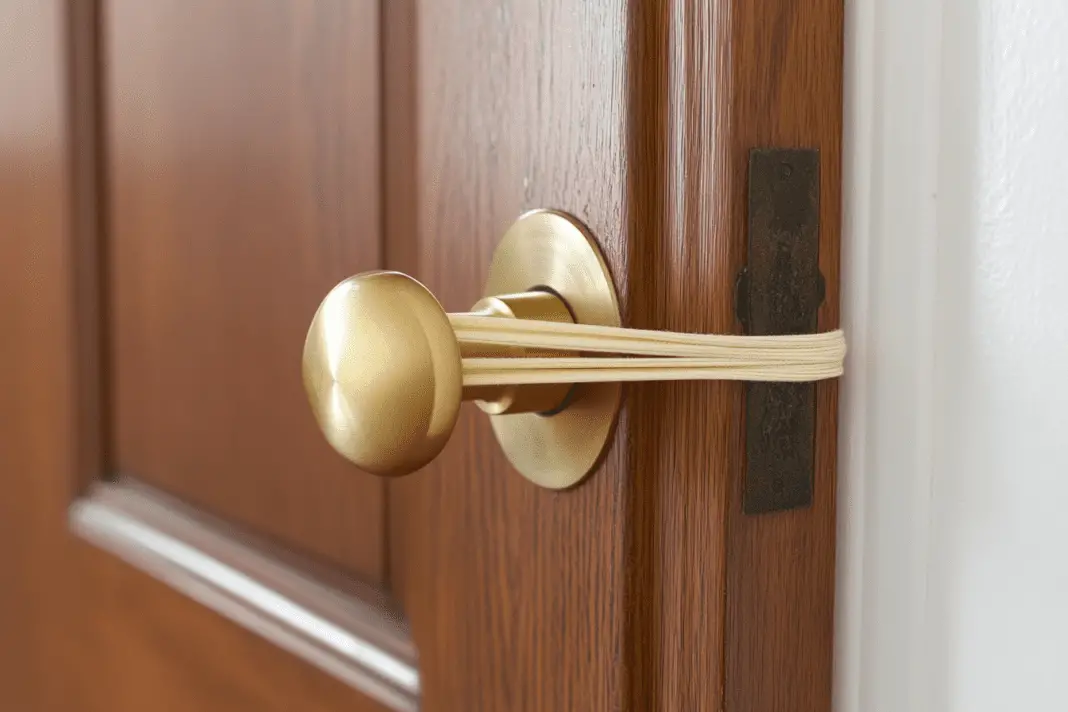
I’ll be straight with you. The first time I watched someone loop a rubber band across their front door, I figured they had lost a bet or given up on life. Then they walked in with four grocery bags, a coffee, and a phone tucked under their chin, bumped the door open with a hip, and I felt like a fool for using my elbow every single trip. This is one of those tiny tricks that makes you wonder why nobody told you sooner. Best part? It costs you nothing, because you almost certainly have a bag of rubber bands rattling around a kitchen drawer right now.
What The Rubber Band Actually Does
Here is the setup. You loop a standard rubber band around one doorknob, twist it into an X shape across the face of the door, then hook the other end around the knob on the opposite side. That twisted section in the middle presses against the little metal bolt that normally pops out and catches the frame. With the band holding that bolt pushed in, the door never actually locks into place. It just rests shut from the pressure against the frame, so you can shove it open with your shoulder and no turning required. It sounds too simple to matter, but the folks over at the DIY crowd swear by it for hauling stuff from the car. Any wide rubber band works. Just pull it off when you’re done so the door locks like normal again.
Why Your Door Clicks In The First Place
Ever stop to think about that click? Most interior doors use what’s called a spring-loaded latch bolt. It’s that cylindrical metal piece sticking out of the edge of the door with one flat side and one angled side. When you swing the door shut, the angled part slides against the strike plate (the metal recess in the frame), gets pushed in, and then the spring shoves it back out once it lines up with the hole. That snap is your click. The knob is connected to a rod that runs through the door, and turning the knob pulls that bolt back in. As one home repair site breaks it down, the rubber band’s only job is to stop that bolt from springing back out. No spring action, no catch, no click. It’s basically a temporary override for a mechanism you’ve used a hundred thousand times without thinking about it.
The Click That Wakes Everyone Up
Any parent who has ever tiptoed into a nursery to check on a sleeping baby knows the horror. You get the door open silently, you confirm the kid is breathing, you back out slowly, and then CLICK. The latch snaps and the baby’s eyes fly open. Total defeat. The rubber band kills that sound because the bolt never engages. One mom writer built a whole life hack around this exact panic, checking on napping kids without waking them. It works great in older houses too, where doors tend to be heavier and louder. You won’t get complete silence, but the difference between a soft thud and a sharp metal snap is night and day. Bonus: if you’ve got a kid who slams doors, the band takes the bang right out of it. No latch to hit the frame means nothing to make that startling crack.
The Bathroom Lock That Traps Toddlers
This one made me stop scrolling. If you have a little kid, you already know the fear of hearing a door click shut and then a tiny voice on the wrong side of it. Toddlers are mobile and curious but not exactly coordinated, so they’ll pull a door closed, accidentally bump the lock, and then have no clue how to get out. Bathrooms are the scariest version of this, given all the water and hard edges. Stretching a rubber band over both knobs keeps the latch from grabbing, so the kid (or a slightly frantic parent) can just push the door open. A parenting newsletter lists a few clever spinoffs too, like looping bands around paired cabinet knobs to keep cleaning supplies out of reach, or pulling a spare sock over a doorknob and cinching it with a band so tiny hands can’t get a grip while adults still can.
The Garage Door Nobody Thinks About
Raise your hand if you’ve ever stepped into the garage to grab one thing, no keys, no phone, and heard the door lock behind you. Now you’re stuck outside your own house in socks. The rubber band fixes this. Toss one on the garage-to-house door before you go out there, and it can’t lock you out. It’s perfect for quick trips when you’re hauling tool boxes, car parts, or storage bins back and forth and don’t want to juggle keys every pass. One home improvement guide recommends grabbing a thick, wide band for heavy doors, the kind that comes wrapped around a bunch of broccoli. For a really heavy door you might link two or three bands together for extra hold. And here’s a smart tip they throw in: tie a little ribbon on the knob as a reminder to actually take the band off later, because it’s shockingly easy to forget it’s there.
The Hotel Room Version That Flips The Whole Idea
Now for the plot twist. Everything above uses the band to keep a door open. But there’s a version that does the opposite. In a hotel room, you can take a strong, thick rubber band, wrap it around the interior door handle, twist it to build tension, and hook it onto the deadbolt or the flip-style security latch. Instead of holding the latch down, you’re building resistance so the door is harder to shove open, even by someone with a keycard. If anyone tried to push in, the band would stretch and give you a beat of warning and a second to react. Is it a fortress? No. It’s a cheap backup that stacks on top of the locks already there, and it should never replace flipping the deadbolt and the latch yourself. But if you travel a lot and like a little extra peace of mind, a couple of fat rubber bands weigh nothing in a suitcase.
Other Ways To Stop A Latch (No Band Required)
The rubber band gets the spotlight, but it’s not the only move. If you’re fresh out of bands, you can fold a small piece of cloth or a dish towel and lay it over the strike plate opening in the frame. That soft barrier blocks the bolt from dropping into the hole, as long as the cloth is thick enough to stop it. A neater option is a strip of painter’s tape right over the face of the bolt, which changes how it meets the frame. Some people even stack a few layers of tape over the strike plate so the bolt just glides across instead of catching. According to one engineering site, the rubber band is still the fastest and cleanest of the bunch, since it leaves zero residue and needs no tools. Tape can peel paint. Cloth can slip. The band just comes right off.
When You Should Absolutely Not Do This
Real talk. If a rubber band is holding the latch open on an exterior door, that door is basically unlocked. Full stop. This is a daytime, hands-full, in-and-out convenience, not something you leave running overnight or when you leave the house. Take it off before bed and before you head out. There’s a fire angle too. Doors that latch properly can help slow down smoke and flames if something ever goes wrong, so a door that can’t close all the way isn’t doing you any favors in an emergency. And one heads-up on the bands themselves: heat and sunlight break rubber down over time, so a band baking on a door will eventually get brittle and snap. Check it now and then and swap it when it looks tired.
The Creepy Rumor That Turned Out To Be Bunk
You may have seen a scary post claiming burglars use rubber bands on door latches to break into homes. It spread fast, and honestly it sounds plausible enough to make you double-check your front door. But here’s the thing. Fact-checkers at Snopes traced it back to a Facebook post from a user named Kim Fleming, put up on April 21, 2016, and found nothing to back it up. No police warnings, no news reports, no confirmed cases. On top of that, a robber wouldn’t gain anything from a band that he couldn’t get from just holding the latch down with his hand. They rated the break-in theory as not credible. The actual rubber band trick, the X across the door that presses the latch open, is the real and legit one. Still, if you ever find a random band on your exterior door that you didn’t put there, just pull it off and make sure everything’s locked. Costs you two seconds.
So there it is. A junk-drawer rubber band that quiets a slamming door, saves you from a garage lockout, keeps a toddler from trapping himself in the bathroom, and even earns its keep in a hotel room. Not bad for something you’d normally toss in the trash.

