

You had a long day. You’re finally on the couch, remote in hand, and your stomach starts rumbling. So you do what any reasonable person does — you raid the fridge. Maybe it’s leftover pizza. Maybe a bowl of ice cream. Maybe a handful of chips. No big deal, right?
Except here’s the thing: what you eat in the hour or two before bed can be the difference between sleeping like a rock and staring at the ceiling at 2 a.m. wondering why your brain won’t shut off. And some of the worst offenders aren’t the ones you’d expect. That “healthy” snack? That glass of wine? That little square of dark chocolate? All potentially sabotaging your night before your head even hits the pillow.
Here are the foods and drinks that deserve a permanent ban from your late-night rotation — and the surprising science behind why they mess with your sleep so badly.
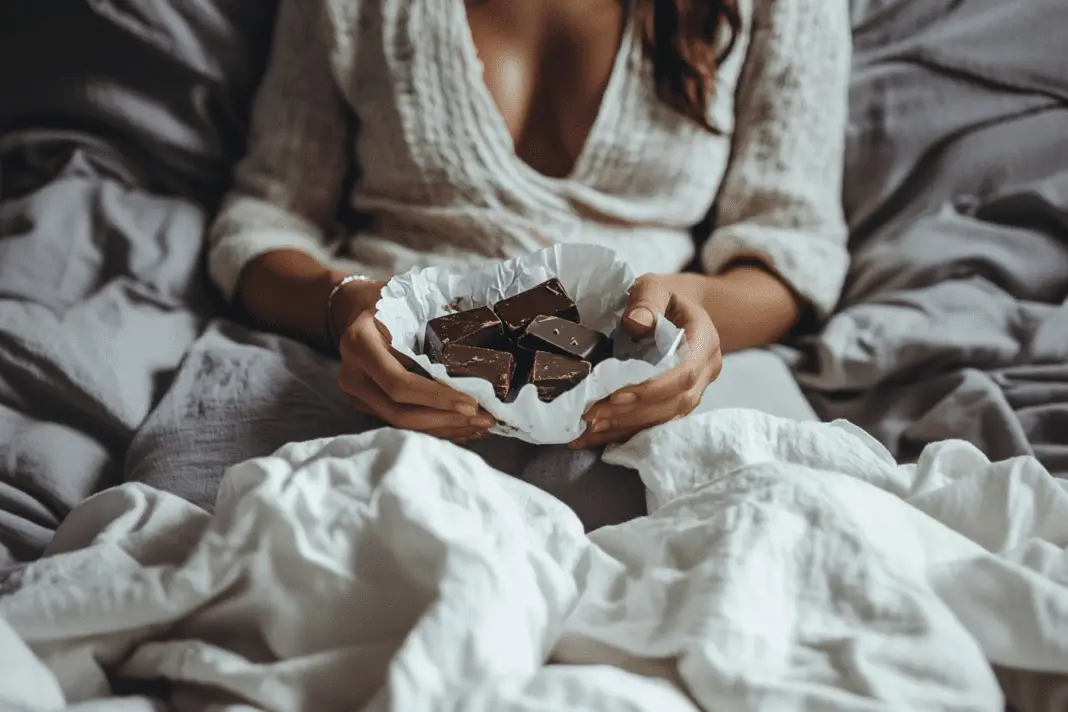
Chocolate Is a Sneaky Sleep Thief
This one genuinely catches people off guard. Chocolate — even the “good for you” dark kind — contains caffeine. Not a ton, sure, but enough to matter when you’re trying to wind down. Dark chocolate with 70 percent cacao or higher has the most, and when you combine that caffeine hit with chocolate’s sugar content, you’ve got a one-two punch working against your sleep.
A study published in the Journal of Clinical Sleep Medicine found that people who ate more sugar and saturated fats experienced less deep sleep and woke up more throughout the night. Chocolate checks both boxes. And during the later stages of sleep, caffeine causes rapid eye movement (REM) to occur more frequently, which is why you might feel absolutely wrecked the next morning even though you technically slept seven or eight hours. The sleep you got just wasn’t very good.
If you’re craving something sweet after dinner, fine. Just keep it to early evening and don’t make a habit of eating a Ghirardelli bar at 10 p.m.
That Nightcap Is Doing the Opposite of What You Think
This is the one nobody wants to hear. A glass of wine before bed feels relaxing. It makes you drowsy. It seems like it’s helping. But alcohol is basically lying to you.
Yes, alcohol makes you fall asleep faster. But it disrupts your natural sleep patterns in the second half of the night. Your body metabolizes alcohol quickly, and when the effects wear off, you wake up. According to the Sleep Foundation, averaging even less than one serving of alcohol per day can decrease sleep quality by more than nine percent. And many mixed drinks contain multiple servings all in one glass.
There’s more. Alcohol relaxes every muscle in your body, including the esophageal sphincter — the little muscle that keeps stomach acid where it belongs. When that relaxes, you get acid reflux. It also worsens obstructive sleep apnea and snoring. So not only are you sleeping worse, you might be keeping your partner up too. Great.
Spicy Food Literally Raises Your Body Temperature
Here’s a fact that most people don’t know: as you approach sleep, your body’s core temperature naturally drops. It’s part of the biological process that signals it’s time to shut down. So eating something that raises your body temperature right before bed is essentially sending the opposite signal to your brain.
Spicy foods — hot sauce, salsa, curries, anything with a kick — contain capsaicin. Capsaicin interferes with your body’s thermoregulation process and elevates your body temperature during the first few sleep cycles, causing measurably poorer sleep quality. It’s not just about heartburn (though that’s a problem too). Your body is physically too warm to settle into restful sleep.
Hot peppers are great for raising your metabolism during the day. At night, that thermogenic effect is the last thing you need. If you love spicy food, eat it at lunch.
Aged Cheese Triggers Your Fight-or-Flight Response
This is the one that genuinely surprised me. Cheese — especially strong or aged varieties like sharp cheddar, Parmesan, and blue cheese — contains high levels of an amino acid called tyramine. Tyramine causes your adrenal gland to release the fight-or-flight hormone, which increases alertness for hours.
Read that again. Your late-night cheese plate is literally triggering the same hormonal response as being chased by a bear. Your body doesn’t know the difference between actual danger and a few slices of aged Gouda. It just knows the adrenaline is flowing and it’s time to stay awake and alert.
Preserved meats like bacon, ham, and pepperoni have the same effect because they also contain tyramine. So that midnight charcuterie board is basically an alarm clock for your nervous system. A small amount of mild cheese with whole-grain crackers is fine — it’s the strong, aged stuff that causes problems.
Greasy Food Can Give You Nightmares
This sounds like an old wives’ tale, but there’s actual research behind it. Studies have shown that eating greasy, fatty foods before bed can make you more prone to nightmares. Potato chips, French fries, cheeseburgers, fried chicken — all of it.
The reason goes beyond bad dreams, though. Heavy, fatty foods are harder to digest than other foods. When you lie down, your body has to keep working to break everything down instead of resting and recovering. This causes bloating, discomfort, and acid reflux. A study found that eating too much saturated fat is specifically linked to lighter sleep with more periods of wakefulness throughout the night.
Doctors recommend finishing your last heavy meal at least two to three hours before bedtime. If you hit up a Whataburger or Five Guys at 9 p.m., just know your body will still be processing that Double at midnight.
Dried Fruit and High-Fiber Veggies Are Terrible Bedtime Snacks
This is the one that frustrates health-conscious people. Dried fruit, broccoli, cauliflower, Brussels sprouts, cabbage, beans — these are all objectively good for you. Eat them at lunch. Eat them at dinner (early dinner). But eating them right before bed is asking for trouble.
The problem is fiber takes longer to digest. That means your digestive system is still grinding away long after you’ve gone to sleep. The result? Gas, bloating, cramping, and pressure that can wake you up or keep you from falling asleep in the first place.
Dried fruit has a double problem: it’s packed with fiber AND loaded with sugar. So you’re getting bloated while simultaneously riding a sugar spike. Registered dietitian Sarah Remmer has pointed out that high-fiber and high-protein foods both require significant energy to digest, and eating them too close to bedtime means your body is doing heavy-duty work when it should be powering down.
Salty Snacks Wreck Your Sleep in Ways You Wouldn’t Guess
Everyone knows too much salt isn’t great for your heart. But did you know it directly messes with your sleep? A study presented at the European Society of Endocrinology found that salty foods — chips, salted nuts, pretzels — contributed to disrupted or superficial sleep. Not just “slightly worse” sleep. Superficial sleep. The kind where you wake up and feel like you barely slept at all.
Too much salt dehydrates your body while simultaneously increasing water retention, which causes tiredness and fatigue — but not the good, sleepy kind. More like the foggy, uncomfortable kind that doesn’t translate into actual rest. Experts recommend staying away from salty snacks at least two to three hours before bed.
And here’s something else worth thinking about: foods with high water content — watermelon, celery, cucumbers — can also hurt your sleep because they’ll have you getting up to use the bathroom at 3 a.m. It’s a lose-lose. Too much salt makes you restless; too much water-rich food makes you restless for a different reason.
So What Can You Actually Eat?
After reading all of that, you might be thinking there’s nothing left. But there are solid options. The trick is pairing a small amount of protein with complex carbs. An apple with almond butter. A banana with a tablespoon of peanut butter (something simple like Smucker’s Organic Natural). A quarter cup of nuts mixed into a small cup of yogurt. Whole-grain crackers with a mild cheese.
Foods containing tryptophan — like dairy, eggs, and turkey — help your body produce melatonin and serotonin, the hormones that actually promote sleep. One study found that people who ate eggs every day reported better sleep. The calcium in dairy helps your body convert tryptophan into melatonin more efficiently.
Herbal tea is another winner. Tart cherry juice blended into a smoothie has shown real promise for reducing insomnia. Just keep portions small. The goal is to quiet your hunger, not fill your stomach. A snack, not a meal.
The two-to-three-hour rule is your best friend here. Finish eating a real dinner by 7 or 8 p.m., and if you need something before bed, keep it light, keep it simple, and keep it boring. Your midnight self will thank your evening self in the morning.

