

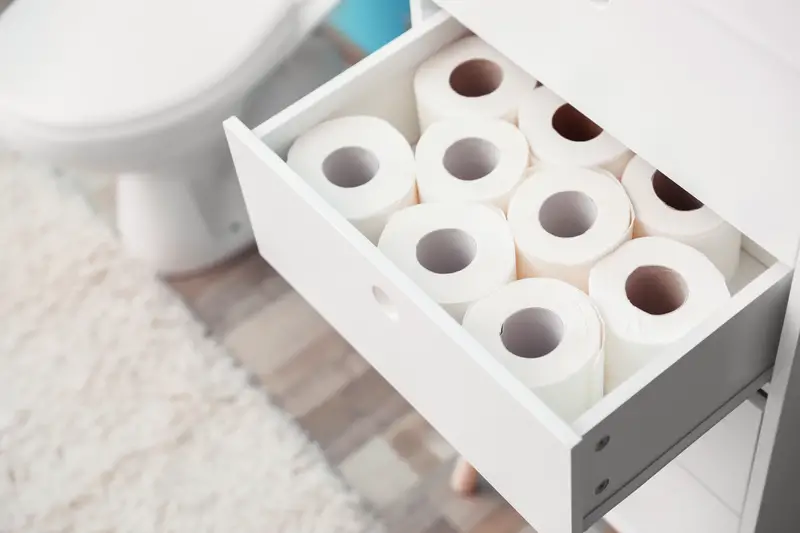
You probably don’t think twice about where you store your toilet paper. It goes in the bathroom, right? Maybe stacked on a shelf above the toilet, sitting in a cute basket on the floor, or perched on the back of the tank. Seems perfectly normal. Turns out, that casual approach to TP storage is doing things to your health that most people never consider — and the science behind it is genuinely unsettling.
Your Toilet Is a Tiny Germ Cannon
Every time you flush a toilet, it fires microscopic particles of whatever was in the bowl into the air. Scientists call this “toilet plume,” and it’s been studied since the 1950s. A 1975 study by microbiologist Charles P. Gerba at the University of Arizona helped bring the concept into the mainstream, and research has only gotten more alarming since then.
Modern studies show that fecal matter can contain up to 1011 viral particles per gram — that’s 100 billion. When you flush, aerosolized droplets carrying bacteria and viruses blast upward and outward, settling on every surface in range. Your toilet paper, if it’s sitting out unwrapped in the same room, is absorbing all of that. And then you’re using it on some of the most sensitive parts of your body.
A study published in Nature confirmed that flushed toilets emit aerosol plumes propelled by a strong jet that angles upward and backward. Researchers noted that in a typical bathroom stall or small home restroom — way smaller than their 300-cubic-meter lab — those aerosol particles would concentrate much more densely than in their experiments. Your bathroom is basically a sealed box where these particles bounce around and land on everything.
Closing the Lid Does Not Fix This
Here’s where it gets worse. You’ve probably heard the advice: close the lid before you flush. It sounds like common sense. But a January 2024 study found there was no statistically significant difference in surface contamination between flushing with the lid up versus down. The aerosols escape around the edges of the lid. Floor contamination levels were actually higher on certain sides of the toilet when the lid was closed, possibly because the lid redirected the plume downward and outward instead of straight up.
The research did find one thing that actually works: scrubbing the toilet bowl with a disinfectant and brush before flushing reduced viral contamination in the bowl water by more than 99.99%. That’s a far cry from the passive “just close the lid” strategy that most of us rely on.
So if closing the lid doesn’t protect your stored toilet paper from fecal plume particles, what does? Moving it out of the blast zone, for starters.
Toilet Paper Dispensers Are Filthier Than the Toilet Itself
Charles Gerba — the same University of Arizona microbiologist who’s been studying bathroom germs for decades — conducted research showing that the average toilet paper dispenser carries 150 times more bacteria than the average toilet seat. Paper towel dispensers weren’t much better, clocking in at over 50 times more bacteria than a toilet seat.
Think about that for a second. The thing you touch right before wiping yourself is dramatically dirtier than the seat you’re sitting on. People clean toilet seats. Nobody cleans the toilet paper holder. It sits there for years, collecting flush plume after flush plume, touched by every hand that reaches for paper — hands that haven’t been washed yet, by the way.
At home, this plays out in a similar way. Your freestanding toilet paper holder, your wall-mounted dispenser, or that decorative basket of rolls next to the toilet are all in the direct path of aerosolized fecal matter. And unlike a toilet seat, which has a hard, non-porous surface, toilet paper is soft and absorbent. It’s basically a sponge for airborne bacteria.
Steam and Humidity Turn Stored TP Into a Mold Farm
The germ-cannon problem is bad enough, but there’s a second issue working against your bathroom-stored toilet paper: moisture. Every hot shower fills the room with steam. That steam gets absorbed by unwrapped toilet paper, softening the fibers and creating exactly the kind of damp environment where mold and mildew thrive.
Mold feeds on organic matter like paper and wood. In a bathroom with poor ventilation — and most American bathrooms have weak exhaust fans or none at all — humidity lingers long after you’ve toweled off. Your toilet paper absorbs that moisture and becomes a breeding ground. If you’ve ever noticed your stored rolls feel slightly soft or have a faint musty smell, that’s not your imagination. That’s the beginning of mold colonization.
Moldy toilet paper should be thrown away immediately. Using it poses real health risks, and damp paper that hasn’t visibly molded yet may already have compromised fibers and microbial growth you can’t see.
Your Bathroom’s Germiest Spot Isn’t Where You Think
A 2011 study by NSF International tested 30 surfaces across 22 homes and found that the germiest spot in the bathroom was the toothbrush holder. While 27% of toilet seats tested positive for mold and yeast, 64% of toothbrush holders did. Twenty-seven percent of toothbrush holders had coliform bacteria — an indicator of fecal contamination — and 14% had staph.
Why? Same reason as the toilet paper problem. The toilet plume sends fecal bacteria airborne, and it lands on whatever damp, porous surface is nearby. Toothbrush holders are usually wet and rarely cleaned. But here’s the thing that should unsettle you: if your toothbrush holder is getting coated in fecal bacteria from across the room, imagine what’s happening to the toilet paper sitting two feet from the bowl.
A 2013 survey found that 64% of Americans flush public toilets with their feet and 60% use paper towels to open bathroom doors. We’re wildly germaphobic about some things and completely oblivious about others — like the fact that we store our most intimate hygiene product in the most contaminated room of the house.
The Chemicals Lurking Inside the Paper Itself
Storage isn’t the only problem. The toilet paper itself carries chemical baggage. A study highlighted by the Environmental Working Group found that toilet paper is a major source of PFAS — perfluoroalkyl and polyfluoroalkyl substances, commonly called “forever chemicals” because they don’t break down in the environment or in your body. These chemicals enter toilet paper during the wood-to-pulp conversion process at paper mills.
Researchers tested both non-organic and recycled toilet paper. Both contained PFAS. The recycled content didn’t affect the concentration of these chemicals at all. PFAS exposure has been linked to immune system suppression, elevated cancer risk, increased cholesterol, and reproductive harm. And you’re pressing this stuff against your body multiple times a day.
There’s also the chlorine problem. Many brands bleach their toilet paper to make it look whiter and feel softer. That bleaching process can produce dioxins and furans — toxic compounds linked to cancer, diabetes, and neurotoxicity, according to research published on IntechOpen. Formaldehyde, used to strengthen toilet paper so it doesn’t fall apart when wet, is another additive in many commercial brands.
What You Should Actually Do About All This
Keep your bulk toilet paper supply out of the bathroom entirely. A hallway closet, linen cabinet, or pantry shelf works fine. Keep it in the original plastic wrap until you’re ready to use it. The wrap blocks moisture, dust, and airborne contaminants from settling into the absorbent fibers.
In the bathroom itself, keep only the roll currently in use. If you like having a spare within arm’s reach, put it in a sealed container — a lidded basket, a closed cabinet, something with a barrier between the roll and the air in the room. Open baskets and freestanding holders look nice on Instagram, but they’re basically serving platters for toilet plume.
Run your exhaust fan during and after every shower for at least 15 to 20 minutes. If you don’t have one, crack a window or leave the door open. Reducing humidity protects everything in your bathroom, not just the toilet paper.
And if you really want to cut down on bacterial contamination, scrub your toilet bowl with disinfectant before flushing — especially after heavy use. That single step does more to reduce airborne pathogens than closing the lid ever will.
Nobody wants to think this hard about toilet paper. But considering it’s something you use on your body five to eight times a day, in a room that’s essentially raining invisible fecal mist, maybe a little extra thought is exactly what’s overdue.

