

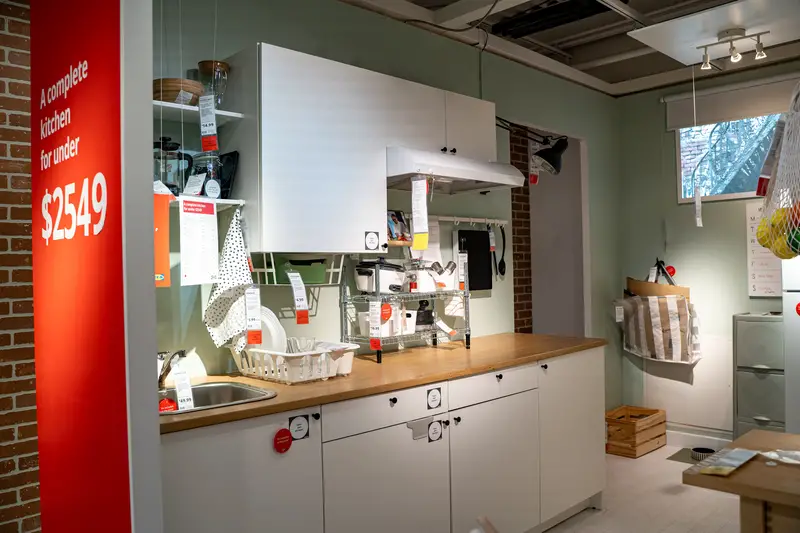
IKEA sells more kitchen cabinets than pretty much anyone on the planet. Walk into any American IKEA on a Saturday and you’ll find couples arguing over cabinet finishes in the showroom kitchens — kitchens that look incredible, by the way. Glossy. Modern. The kind of kitchen you pin on Pinterest at midnight and then daydream about during Monday meetings.
But there’s a wide gap between what those showroom kitchens suggest and what actually shows up at your door in a stack of flat-pack boxes. IKEA has built a brilliant system for selling affordable kitchens, but there are things they’re banking on you not knowing before you swipe your card. Some of it is about materials. Some of it is about what’s missing from the box. And some of it is about what happens three, five, or ten years after installation.
The Cabinets Aren’t Made of What You Think
Here’s the thing IKEA doesn’t exactly advertise on those gorgeous showroom displays: their cabinet boxes are made from particle board covered in a melamine foil finish. Not solid wood. Not plywood. Particle board — the same stuff in that college dorm bookshelf you threw away after sophomore year.
Now, to be fair, IKEA’s particle board is better than bargain-bin stuff. Their SEKTION system is engineered to be functional and it does work for a lot of people. But particle board has a well-documented weakness: water. And where do kitchens have the most water? Right around the sink. Under the dishwasher. Near the fridge’s ice line. The exact spots where your cabinets live.
One smart buyer on a review site knew this going in and replaced the sink cabinet floor with MDO plywood and sealed all the edges specifically to prevent water damage. That’s someone who understood what IKEA wasn’t going to tell them. Compare that to custom cabinets, which typically use solid wood or furniture-grade plywood — materials that can handle moisture without swelling up like a sponge.
Your Cabinets Show Up Without Some Pretty Important Parts
You’d assume that when you spend thousands of dollars on kitchen cabinets, they’d come complete. They don’t. SEKTION cabinets arrive without pulls or knobs. You buy those separately. That sounds minor until you price out handles for an entire kitchen and realize you just added a few hundred bucks to your total.
But it gets worse. One customer spent $10,000 on an IKEA kitchen order and received an incomplete delivery — no feet, no hinges, missing sink, missing cabinets, and two of the most expensive pieces arrived damaged. Another customer waited almost four months for delivery after ordering in mid-July. IKEA even canceled their second order without explanation. Four months. For particle board cabinets.
Meanwhile, one reviewer on a different forum ordered an entire kitchen over the phone in ten minutes and had it delivered in three weeks. So the experience is wildly inconsistent, and IKEA doesn’t go out of its way to warn you about that.
The 25-Year Warranty Isn’t What It Sounds Like
IKEA’s SEKTION kitchen system comes with a 25-year limited warranty. That sounds amazing. It sounds like they’re standing behind their product for a quarter century. Read the fine print, though.
One customer bought Applad cabinet fronts in 2014 and within a few years the paint started cracking and peeling off. They contacted IKEA, and a phone support rep actually acknowledged this was a known problem with their painted fronts. Good — sounds like a warranty claim, right? Two days later, IKEA denied the claim, calling it “normal wear and tear.” The customer ended up buying the fronts twice out of pocket.
So yes, there’s a warranty. But if IKEA decides your peeling paint is “normal,” you’re on your own. That’s a pretty big asterisk on a 25-year promise.
Professional Installers Won’t Touch Them (And There’s a Reason)
IKEA uses European frameless construction with metric dimensions and a hanging rail system that is completely different from how American cabinets are installed. This isn’t a small detail. It means many experienced American cabinet installers flat-out refuse to work with IKEA products because the assembly requirements and installation methods are unfamiliar to them.
IKEA will recommend their own partner installers, but as one industry professional pointed out, the store will recommend them whether or not they’re actually a good fit for your project. One customer had an IKEA-recommended installer through a company called Traemand — and when cabinets needed fixing just 18 months after installation, the installer left them hanging for months with no resolution.
And if you decide to DIY? Professional installers say any homeowner can probably do it, but it’ll take way longer and won’t be perfect. Poor installation is actually one of the biggest reasons IKEA kitchens fail early, especially in older homes where walls aren’t perfectly straight or square.
The Price Gap Is Smaller Than IKEA Wants You to Believe
IKEA’s whole pitch is affordability. A complete kitchen renovation using their cabinets often runs $7,000 to $15,000. Custom cabinets for the same kitchen might start at $20,000. So yeah, IKEA is cheaper. But how much cheaper, really, once you add everything up?
You’re buying handles separately. You’re possibly paying $69 or more for delivery. You might be hiring an installer because you realized 200 flat-pack boxes is more than you bargained for. You’ll likely need filler panels because IKEA’s metric sizes don’t perfectly fit American kitchens. Crown molding to close that gap at the top? Extra. Cover panels for exposed sides? Extra. And those exposed cabinet sides are where cost quietly balloons — one DIY blogger noted that the tall vertical cabinet she planned was shockingly expensive simply because both sides were exposed, requiring pricey trim pieces.
When you factor in replacement costs within 10-15 years — versus custom cabinets lasting 25-50 years — the math starts looking very different.
The One Cabinet That Falls Apart in Every Kitchen
There’s one specific cabinet in every IKEA kitchen that takes a beating, and nobody warns you about it: the trash pull-out. Multiple homeowners across different review sites all say the same thing — it’s consistently the worst cabinet for wear no matter what brand you buy.
One person had to touch up the paint on their trash pull-out half a dozen times after only seven months. And this wasn’t even an IKEA cabinet — it was a mid-quality brand. The point is, IKEA’s particle board and melamine finish are even less equipped to handle that kind of daily abuse. Every time you step on the pedal or yank out the drawer to throw something away, you’re stressing the cheapest materials in the kitchen at the highest-traffic spot.
There’s a Secret Hack That Changes Everything
Here’s where it gets interesting. A growing number of homeowners and professional installers have figured out a trick: buy IKEA’s cheap cabinet boxes and throw away the doors. Then order custom doors and drawer fronts from third-party companies like Semihandmade or Kokeena.
You get the affordability of IKEA’s SEKTION frames — which, honestly, are the strongest part of the whole system — paired with custom-quality fronts in styles and colors IKEA doesn’t offer. One reviewer specifically bought bottom-of-the-line SEKTION boxes planning from the start to replace the fronts with bamboo plywood doors and swap the awkward plastic feet for a solid wood base. The steel drawers and internal hardware? They called it top quality. Assembly was fast and easy.
Professional installers take this even further. One Maryland contractor builds custom frames to eliminate wasted filler space — instead of a useless six-inch filler strip, his customers get five extra inches of drawer space. Another installer in Virginia hacks SEKTION cabinets with angled fillers to keep corner sinks at 45 degrees, avoiding expensive plumbing work.
Some IKEA Kitchens Last a Decade (And Some Don’t Last Two Years)
The range of experiences with IKEA cabinets is wild. One family has had their IKEA kitchen for ten years with three kids and says it’s held up wonderfully — drawers slide well, hinges are holding, shelves are sturdy. Their only complaints are some scratching on dark lower doors and grease stains on white uppers.
Another family has had IKEA cabinets for 15 years in a rental property, withstanding two kids, and they’re still fine. Someone else reported seven years with zero issues.
But then there are the people who needed repairs or replacements after just two years. The difference almost always comes down to two things: installation quality and moisture exposure. If your walls aren’t level, if there’s any gap where water can seep into particle board, or if the cabinets weren’t assembled precisely right, the clock starts ticking fast.
The honest truth is that IKEA cabinets can work. They can last. But they need more babying than IKEA lets on, and the margin for error is razor thin compared to cabinets built from solid wood or plywood. Nobody in that beautiful showroom is going to tell you that the kitchen you’re admiring is one slow leak away from a swollen, crumbling mess. But now you know.

