

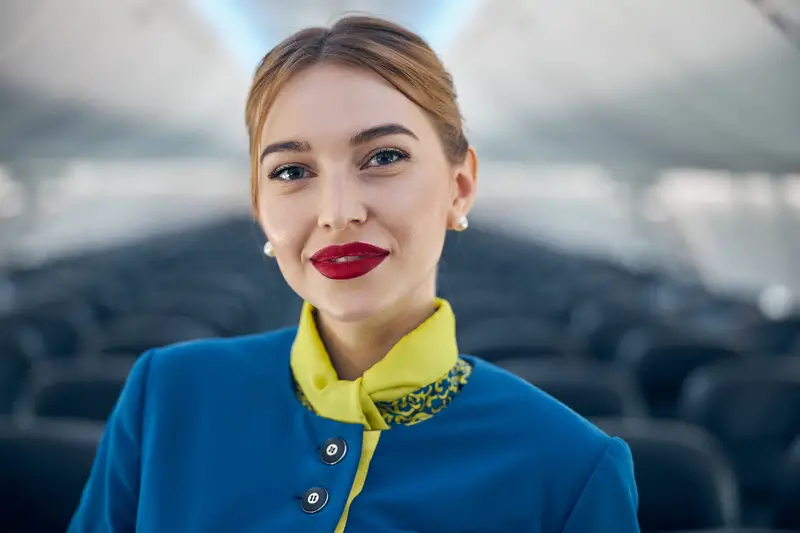
Ever notice how flight attendants sometimes look like they just stepped off a runway while the rest of us shuffle onto planes looking like we lost a fight with our alarm clock? There’s something about that crisp uniform and bold red lip that screams “professional” even at 6 a.m. Turns out, that signature red lipstick wasn’t always just a fashion statement. For decades, it served a practical purpose that most passengers never knew about. According to former flight attendant Heather Poole, who spent 20 years flying for a major U.S. airline, that crimson pout might actually help save lives in an emergency situation.
Red lipstick helps passengers read lips during emergencies
Imagine being on a plane during an emergency evacuation. The cabin is loud, people are panicking, and you can barely hear anything over the chaos. In situations like these, flight attendants need every tool available to communicate critical instructions to passengers. That’s where red lipstick comes in. The bold color makes lips stand out, making it easier for passengers to read what flight attendants are saying even when they can’t hear them. It’s a simple visual aid that could make the difference between confusion and clarity when seconds count.
Poole revealed in her book “Cruising Attitude: Tales of Crashpads, Crew Drama, and Crazy Passengers at 35,000 Feet” that instructors told her flight attendants wear red lipstick “so passengers can read your lips during an emergency.” She admitted she wasn’t entirely sure if the instructor was serious at the time. But whether it was an official FAA directive or just airline tradition, the practice was taken seriously. During her training and throughout much of her career, lipstick had to be worn at all times. “Lipstick was serious business,” she wrote.
The golden age of aviation had strict beauty standards
Back in the 1950s and 1960s, when flying was considered glamorous and exclusive, airlines enforced incredibly rigid appearance rules for their flight attendants. These weren’t just guidelines—they were strict requirements that dictated everything from weight to makeup shades. Pan Am, one of the most famous airlines of that era, hired only young women who met very specific beauty standards. They enforced rules about height, weight, age, and even marital status. Flight attendants, then called stewardesses, were essentially expected to look like models while performing their safety and service duties.
One particularly extreme example involved makeup requirements. According to a viral social media post, Anne Sweeney, a Pan Am crew member in 1964, recalled that “Revlon ruled our makeup, and we were required to wear Persian Melon lipstick and matching nail polish.” The reason? Charles Revlon was on the Board of Directors. Sweeney noted that she “looked like a corpse in Persian Melon” but still had to get written permission from the grooming instructor to wear a different shade. Persian Melon, for the record, was a bright pink shade that definitely didn’t flatter everyone. These kinds of beauty standards seem absurd by today’s standards.
Red conveys authority and confidence at 35,000 feet
Beyond the practical communication benefits, there’s a psychological component to wearing red lipstick. The color red naturally draws attention and conveys confidence and authority. When a flight attendant is managing a cabin full of stressed or frightened passengers, projecting an image of control and competence becomes essential. A bold red lip sends a nonverbal message that says “I know what I’m doing, and you should listen to me.” This matters especially during emergencies when passengers need to trust and follow instructions quickly without questioning or hesitating.
Flight attendants aren’t just there to serve drinks and hand out snacks. They’re trained safety professionals responsible for evacuating hundreds of people if something goes wrong. Looking authoritative helps them do their job more effectively. The red lipstick becomes part of a larger uniform strategy designed to make flight attendants instantly recognizable and trustworthy. It’s similar to how police officers wear uniforms and badges—the visual markers help establish their role and authority. In the high-pressure environment of an aircraft cabin, every detail that reinforces a flight attendant’s authority matters.
Most airlines no longer require red lipstick
Times have changed significantly since the days of mandatory Persian Melon. Modern airlines have largely moved away from the strict, appearance-focused rules that dominated the industry for decades. Sydney Anisitine, a veteran flight attendant who has worked for every major U.S. airline, says she’s never even heard of the red lipstick emergency rule. When she sees colleagues wearing bright lipstick today, it’s purely a personal style choice, not a requirement. Most contemporary airlines now emphasize comfort, practicality, and inclusivity over rigid beauty standards that unfairly targeted women.
This shift reflects broader changes in workplace culture and gender equality. The old rules weren’t just about safety or professionalism—they were often about controlling women’s appearances in ways that had nothing to do with job performance. Today’s flight attendants have more freedom to express themselves while still maintaining a professional appearance. Some airlines have dropped mandatory makeup requirements entirely. Others have updated their grooming standards to be more flexible and inclusive. The focus has shifted from enforcing a specific look to ensuring flight attendants present themselves professionally in whatever way works best for them. As Anisitine noted, bright lipstick is now just a style choice.
Emirates still requires their signature red lip
While most airlines have relaxed their beauty standards, Emirates Airlines still maintains strict grooming requirements that include wearing red lipstick. The Dubai-based airline is known for its maximalist approach to appearance standards, and female flight attendants must wear what’s called “Emirates red” lipstick and lip liner as part of their uniform. This isn’t optional—it’s a mandatory part of the job. Emirates takes these standards so seriously that they operate the Emirates Beauty Hub in Dubai, where flight attendants receive professional training on hair, skin, and makeup application.
At the Beauty Hub, experts teach flight attendants how to achieve the perfect red lip that will last through long international flights. Marine Boutboul, a makeup artist at the Emirates Beauty Hub, shared the secret with Conde Nast Traveler: “Make sure lips are hydrated before starting and go in with liner first.” Emirates has partnerships with luxury brands like Dior and Davines, though flight attendants posting their routines online seem to have some flexibility in the specific products they use. One Emirates flight attendant on YouTube, Rhony Claire, demonstrated using MAC Cosmetics products but noted that “for an overall rule, for the ‘Emirates red’ it should be a blue-based lipstick.” The airline’s commitment to this signature look remains strong.
Different airlines have different grooming policies today
The airline industry isn’t monolithic when it comes to appearance standards. Each carrier sets its own policies based on brand identity, corporate culture, and regional expectations. Some airlines have embraced more relaxed standards, allowing flight attendants greater personal expression. Others, particularly international carriers from certain regions, maintain stricter grooming codes that reflect cultural norms and brand positioning. U.S. carriers generally lean toward more flexible policies now, while Middle Eastern and some Asian airlines often maintain more traditional appearance requirements.
This variation means the flight attendant you see on a domestic Southwest flight might look quite different from one on an Emirates or Singapore Airlines flight. Neither approach is necessarily better—they just reflect different priorities and cultural contexts. What matters most is that flight attendants can do their jobs effectively and safely. As long as they’re easily identifiable to passengers and can perform their safety duties, the specific details of their appearance matter less than they once did. The shift toward more inclusive standards has been welcomed by many in the industry.
Flight attendants are becoming beauty influencers
Social media has opened up new opportunities for flight attendants to share their expertise and build followings based on their iconic looks. Platforms like TikTok and YouTube are full of flight attendants demonstrating their makeup routines, sharing product recommendations, and offering tips for achieving long-lasting looks. Some have turned this into lucrative side careers as beauty influencers, partnering with cosmetics brands and building substantial online audiences. It’s a fascinating evolution—what was once a strict requirement has become an opportunity for personal branding and entrepreneurship.
These flight attendants share practical advice that applies beyond aviation. How do you make lipstick last for 12 hours straight? What products hold up in dry cabin air? Their tips resonate with anyone looking for long-wearing makeup solutions. One Emirates flight attendant’s TikTok video featuring 3CE’s Lazy Pop Lip Stain in “Coolest” shows how flight attendants are leveraging their unique expertise. They’re no longer just following rules—they’re setting trends and building communities. This represents a major shift in how flight attendants relate to the beauty standards that have long been part of their profession. Now they’re taking control of the narrative and sharing their knowledge on their own terms.
The emergency communication theory remains unproven
Despite the widespread circulation of the red lipstick emergency story, it’s worth noting that this theory has never been officially confirmed by aviation authorities. Heather Poole herself expressed uncertainty about whether her instructor was serious when explaining the safety rationale. No FAA documentation specifically mandates red lipstick for emergency communication purposes. It may have been one of those unofficial practices that got passed down through training programs without ever being an actual regulation. Or it might have been an after-the-fact justification for a rule that was really about maintaining a certain aesthetic.
That doesn’t mean the theory is wrong—it actually makes logical sense that high-contrast lip color would aid in lip reading during noisy emergencies. But it’s important to distinguish between official safety protocols and industry traditions that may or may not have practical benefits. Many current flight attendants, like Sydney Anisitine, have never heard this explanation, which suggests it wasn’t universally taught or believed within the industry. The truth probably lies somewhere in the middle: red lipstick became standard for aesthetic reasons tied to airline branding, and the emergency communication benefit was a convenient side effect that some instructors emphasized. Either way, it makes for a compelling story.
The tradition continues as a style choice
Even though it’s no longer required by most airlines, many flight attendants still choose to wear red lipstick. It’s become part of the classic flight attendant aesthetic that people recognize and associate with aviation. Some wear it as a nod to tradition, honoring the generations of flight attendants who came before them. Others simply like how it looks and feels. Red lipstick has a way of making people feel polished and put-together, which is helpful when your job involves interacting with hundreds of strangers while managing the challenges of air travel.
There’s also something empowering about choosing to wear red lipstick rather than being forced to wear it. When it’s a requirement, it can feel oppressive and controlling. When it’s a personal choice, it becomes an expression of individual style and professionalism. Modern flight attendants who opt for red lips are reclaiming a tradition on their own terms. They’re keeping the iconic look alive while also asserting their right to make their own decisions about their appearance. It’s a small but meaningful shift that reflects the broader evolution of the profession. Whether worn for safety, style, or tradition, that bold red lip remains a recognizable part of aviation culture.
Next time you board a plane and notice a flight attendant wearing red lipstick, you’ll know there’s more to it than just looking good. Whether it’s a personal style choice, an airline requirement, or a subtle safety tool, that crimson color carries decades of aviation history. The evolution from strict mandate to personal preference reflects broader changes in workplace culture and gender equality. While some airlines like Emirates maintain traditional standards, most have moved toward more flexible policies that respect individual expression while maintaining professionalism.

