

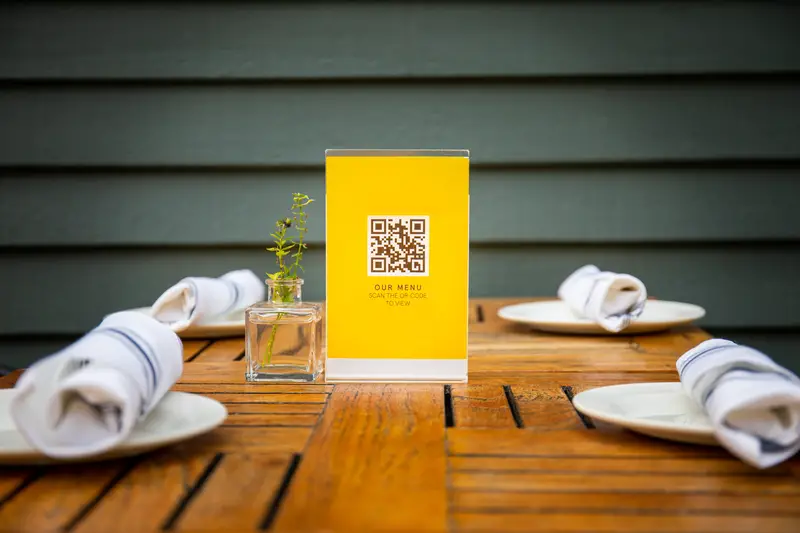
Here’s a scene that plays out in restaurants across America every single day: A couple in their seventies sits down at a trendy spot. The server smiles, gestures at a small square printed on a card, and walks away. The woman digs through her purse for reading glasses. The husband pulls out a flip phone. They stare at the QR code like it’s written in a language that doesn’t exist yet.
Then they leave. They go to a diner with laminated menus and cushioned booths and a server who’s worked there since the Clinton administration.
This is happening everywhere, and it’s not just a generational gripe. The QR code menu — that little pixelated square that replaced the thing you used to hold in your hands — has become one of the most divisive changes in American dining. And the backlash is way bigger than you’d think.
Almost Half of All Customers Hate QR Code Menus
Let’s get one thing straight: this isn’t just boomers being stubborn. A 2023 study by William Blair found that 47% of consumers said they weren’t comfortable using QR codes at restaurants. That’s nearly half of all diners. Among people over 60, that number jumped to 65%. But even among 45-to-60-year-olds, only 6% said they were willing to use them. Six percent.
Meanwhile, 62% of all QR code scans come from people aged 18 to 34. So restaurants adopted a technology that basically only works for one slice of their customer base and told everyone else to deal with it.
One Reddit user reported watching a boomer tell their server they “don’t read square.” Funny? Sure. But also kind of the perfect summary of how a huge chunk of Americans feel about being handed a piece of paper with a pixelated box and told to figure it out themselves.
Restaurants Actually Lost Money on QR Codes
Here’s the part that should make restaurant owners sweat. QR codes didn’t just annoy people — they hurt the bottom line. One restaurant group saw a 10% decrease in check averages after switching to QR code menus. The reason? People didn’t scroll through everything. They’d see the first few items, pick something, and stop. All those appetizers, desserts, and specialty drinks that servers used to point out? Gone. Nobody’s impulse-ordering a $14 cocktail when they’re squinting at a PDF on a phone screen.
Tips took a hit too. When you remove the human interaction of ordering — the back-and-forth, the recommendations, the “oh, you have to try the short rib” — you also remove the moment where a customer feels a connection with their server. And connected customers tip better. That’s just how it works.
Only 31% of consumers said they felt positively about viewing menus via QR code, according to a study by PYMNTS Intelligence and Paytronix. That means roughly seven out of ten diners either disliked it or were indifferent. Not exactly a ringing endorsement for a technology that was supposed to make everything better.
The Menus Were Bad Even If You Knew How To Use Them
Even for people who are perfectly comfortable with technology, QR code menus were often a terrible experience. A lot of restaurants didn’t invest in properly formatted mobile menus. They just uploaded a PDF — the same one designed to be printed on an 11×17 sheet — and linked it to a QR code. So now you’re zooming in and out on your phone like you’re examining evidence at a crime scene, trying to figure out whether that says “braised” or “brined.”
Then there’s the WiFi problem. Some restaurants require you to be on their network to load the menu, but their WiFi barely works. If your phone battery is low? Good luck. Some codes prompt you to download an app before you can even see what’s for dinner. Others lead to pages so bloated with graphics that they take forever to load.
A veteran restaurateur with 35 years in the business wrote about how they used to obsess over the physical menu — the weight of it, the texture, the font size. Heavy enough to feel substantial, but not so heavy it tired your wrists. That kind of attention to detail vanished overnight when restaurants replaced all of it with a sticker on the table.
Self-Ordering Kiosks Have Their Own Problems
QR codes aren’t the only tech trend making people uncomfortable. Self-ordering kiosks — those big touchscreens at fast food counters — are spreading fast. And they come with a side of anxiety nobody ordered.
A Temple University study published in the Journal of Hospitality and Tourism Research found that customers order less food and feel more stress when using kiosks as a line forms behind them. The reason is kind of brilliant in a sad way: when you’re ordering from a person and something goes wrong, you blame the employee. But when you’re using a kiosk and you’re slow or confused, that’s on you. You feel the pressure of everyone behind you, and you rush through, skipping items and sticking to whatever’s familiar.
Customers at kiosks were less likely to try new menu items. They defaulted to what they already knew. So much for encouraging people to try that new seasonal sandwich.
Mystery shopping data from InTouch Insight found that kiosks scored just 66% on friendliness, compared to 78% for in-person ordering. Glitches showed up in about 7% of orders, with one brand alone accounting for 15% of all technical problems. Shoppers reported not understanding how to make items into combos, not being able to get receipts, and having nobody around to help.
Shake Shack Tried Going Cashless and Customers Revolted
Shake Shack rolled out a cash-free location where traditional cashiers were replaced by “hospitality champs” who helped customers use ordering kiosks. The backlash was immediate. Customers went online to complain about confusing systems, a lack of employee support, and the simple desire to be able to pay with actual money. Shake Shack ended up reinstating cashiers and shelving plans for a cashless future.
The CEO of Apple-Metro, which operates over 30 Applebee’s franchises, said his restaurants won’t go cashless anytime soon. His reasoning was pretty simple: refusing to serve someone because of how they want to pay is just bad service.
And the numbers back that up. According to the FDIC, 8.4 million U.S. households don’t have a bank account. Twenty-two percent of Americans don’t have a credit card. Going cashless doesn’t just inconvenience people — it shuts out millions of them entirely. Several states have started considering outright bans on cashless restaurants to prevent discrimination against children, the elderly, and low-income Americans.
The Noise and Darkness Problem Nobody Talks About
While QR codes get most of the attention, there’s a whole constellation of restaurant trends driving older Americans out the door. And honestly, they’d probably drive you crazy too if you thought about it.
Music volume is a big one. That same veteran restaurateur described how their restaurant used to have carpeting, upholstered seats, and acoustic panels hidden in the ceiling. Music was present but forgettable — which was the point. Now? Exposed brick, concrete floors, open kitchens, and bass lines that literally vibrate wine glasses. Older couples who’ve been married forty years end up sitting across from each other in defeated silence, pointing and gesturing because talking is impossible.
Then there’s the lighting — or rather, the lack of it. Dim lighting is “ambiance” now. But when customers are pulling out their phone flashlights to read the check, something’s gone wrong. As one writer put it: “You know what we used to call it when you couldn’t see your food properly? A power outage.”
Boomers Are Still the Customers Restaurants Need Most
Here’s the irony in all of this. Boomers are, broadly speaking, the most loyal restaurant customers in America. They go out for special occasions and casual dinners alike, more than other generations. They have higher-than-average disposable income. And a study commissioned by Eater found that boomers were actually the generation most likely to seek out new foods and dining experiences. They’re not scared of trying things. They just don’t want to take a tech exam to do it.
Meanwhile, chain restaurants raised prices by an average of 42% between 2020 and 2025. Americans now spend $166 per month on dining out. More than 60% of boomers said a fair price was one of their top factors in picking a restaurant. They’re not cheap — they just remember when the deal was simpler: you sit down, someone hands you a menu, you pick your food, you eat it, you pay for it, and you leave.
The good news? A lot of restaurants are getting the message. By 2024, widespread backlash was already pushing many places to bring back paper menus. Some went back entirely. Others now offer both options. Because as it turns out, the best technology for a restaurant might just be a laminated piece of cardstock and a person who asks how your day is going.

