

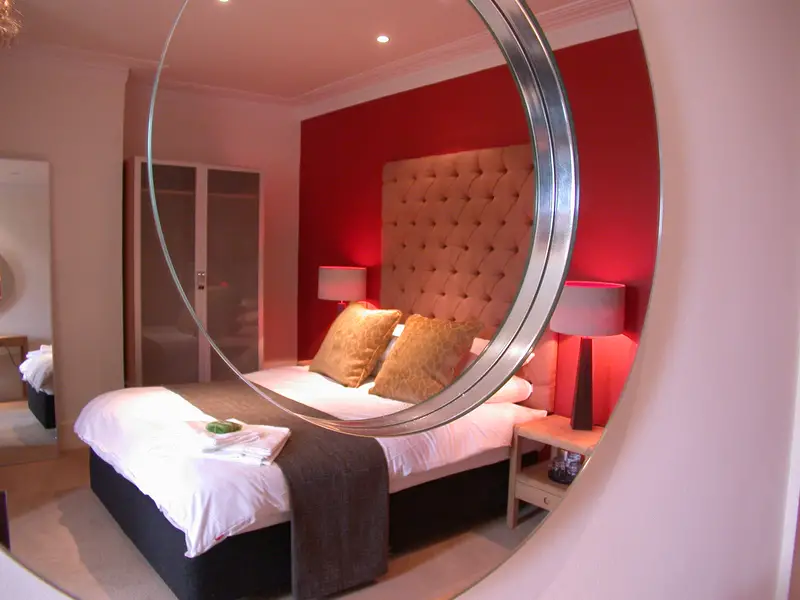
Ever checked into a hotel room and felt a little weird about the mirror placement? Maybe it seems too big, or it’s positioned in an odd spot that makes you wonder who might be watching from the other side. While transparent mirrors (often called two-way mirrors) aren’t common in hotels, they do exist, and knowing how to spot one can give you peace of mind during your stay. The good news is that there are several simple tests you can perform right in your room to figure out whether you’re dealing with a regular mirror or something more concerning.
The fingernail test works in most situations
The easiest way to check your hotel mirror is by using your fingernail. Press your fingernail directly against the reflective surface and look closely at the gap between your actual nail and its reflection. If you see a noticeable space between the two, you’re looking at a regular mirror. This gap exists because standard mirrors have a protective layer of glass placed over the reflective coating, which creates that separation you can see.
On the other hand, if your fingernail appears to touch its reflection directly with no gap at all, this could indicate a transparent mirror. These mirrors have the reflective coating applied right at the surface rather than behind a protective layer. Keep in mind that this test isn’t foolproof, especially if you’re dealing with expensive mirrors that use front-surface coating, but those are rare in hotel settings. The angle you’re looking from and the lighting in the room can also affect what you see, so try the test from multiple positions before drawing conclusions.
Mirror placement tells you a lot about what you’re seeing
Take a good look at how the mirror is installed in your room. Most regular mirrors are simply hung on a wall or mounted with brackets that you can see. If you can spot the edges of the mirror and see that it’s sitting in front of a solid wall, you can usually relax. Regular mirrors don’t need any special installation beyond basic mounting hardware, and they typically have visible backing or frames.
Transparent mirrors are different because they need to be set into the wall itself to create a viewing space on the other side. If your mirror looks like it’s built directly into the wall with no visible mounting hardware, and you can’t see any backing behind it, that’s worth investigating further. The lighting setup matters too. For a transparent mirror to work properly, the room on the viewing side needs to be darker than the room being observed. This means if you’re in a brightly lit bathroom with a suspicious mirror, the room behind it would need to be kept dark for anyone to see through it.
Pressing your face against the mirror reveals hidden spaces
Here’s a technique that might make you feel a bit silly, but it works. Turn off the lights in your hotel room or bathroom, and press your face right up against the mirror. Cup your hands around your eyes to block out any remaining light from your side. Now wait a few seconds for your eyes to adjust and look carefully at what you can see through the glass.
With a regular mirror, you’ll just see darkness or maybe the reflection of your own eyes. But with a transparent mirror, you might be able to see shapes, objects, or even light sources in the room on the other side. This test works because you’re essentially reversing the lighting conditions that make transparent mirrors function. By making your side darker and blocking light with your hands, you’re creating the same viewing advantage that an observer would normally have. If you spot anything that looks like another room, furniture, or equipment on the other side, that’s a major red flag.
The knocking test reveals what’s behind the surface
Sound can tell you a lot about what you’re dealing with. Use your knuckles to gently tap on different parts of the mirror surface and listen carefully to the sound it makes. A regular mirror mounted on a wall will produce a dull, flat sound because the wall behind it absorbs and dampens the noise. There’s typically very little space between the mirror and the solid wall it’s hanging on.
A transparent mirror set into a wall will sound completely different when you tap it. Because there’s an open space or room behind it, the sound will be more hollow and echoey, similar to knocking on a window. Try tapping on various spots across the mirror surface. If the entire mirror produces that hollow sound consistently, while the wall around it sounds solid, you might have found a transparent mirror. This audio test is particularly useful when combined with the other methods because it gives you additional confirmation beyond just visual inspection.
Understanding how transparent mirrors actually work
Transparent mirrors aren’t some high-tech spy gadget from the movies. They’re actually pretty straightforward in how they operate. The mirror is coated with a very thin layer of metal that reflects some light while allowing some light to pass through. You’ve probably seen these in crime shows during interrogation scenes, where the suspect sees their reflection but detectives can watch from the other side.
The key to making these work is the lighting difference between the two rooms. The room being observed needs to be much brighter than the viewing room. When you’re standing in a bright hotel bathroom looking at your reflection, someone in a dark room on the other side could potentially see you clearly. The first transparent mirror was patented way back in 1903, and the basic technology hasn’t changed much since then. They’re also called one-way mirrors, half-silvered mirrors, or one-way glass, though transparent mirror is probably the most accurate term for what they actually do.
Looking for unusual mirror locations in your room
Pay attention to where mirrors are positioned in your hotel room. Most hotels place mirrors in predictable spots like above the bathroom sink, inside closet doors, or on the back of the bathroom door. These locations make sense for getting ready in the morning or checking your outfit before heading out. If you find a large mirror in a weird spot that doesn’t serve an obvious purpose, that’s worth investigating.
Mirrors that face the bed, shower, or toilet area are particularly suspicious, especially if they’re large and built into the wall rather than simply hung there. Think about whether the mirror placement makes practical sense for a hotel guest. A full-length mirror near the entrance? Normal. A massive mirror on the ceiling above the bed in a standard hotel? Weird. A mirror with a perfect view of the shower or bathtub? Definitely worth checking out. Trust your instincts about whether the mirror placement seems designed for your convenience or for someone else’s viewing.
Using your phone flashlight as an inspection tool
Your smartphone can be surprisingly useful for checking mirrors. Turn on your phone’s flashlight and hold it at different angles against the mirror surface. Watch how the light reflects and whether you can see anything unusual. With a regular mirror, the light will reflect back at you in a predictable way, and you won’t see any variation in the reflection across the surface.
With a transparent mirror, you might notice that the flashlight beam seems to penetrate slightly into the surface, or you might see faint shapes or shadows behind the reflective coating. Move the flashlight slowly across the entire mirror surface and look for any inconsistencies in how it reflects. You can also try shining the light from the side of the mirror, where it meets the wall. If there’s a gap or opening that suggests a space behind the mirror, that’s another clue. This method works best in a darkened room where the bright flashlight creates maximum contrast against the mirror surface.
What to do if you find a transparent mirror
If your tests suggest that you’ve found a transparent mirror in your hotel room, don’t panic, but do take action immediately. First, cover the mirror with a towel, blanket, or anything else you can find. Then contact the front desk and explain what you’ve discovered. Most legitimate hotels will take this seriously and either move you to a different room or investigate the situation right away.
Document everything with photos and videos showing the mirror, its location, and the results of your tests. If the hotel doesn’t respond appropriately to your concerns, contact local police. In many places, installing transparent mirrors in private spaces like hotel rooms or bathrooms is illegal. You should also report the hotel to travel websites and review platforms to warn other travelers. Consider checking out immediately and finding different accommodations, even if it means losing money on your reservation. Your privacy and safety are worth more than the cost of a hotel room, and you shouldn’t stay somewhere that makes you feel unsafe or violated.
Checking mirrors in other locations beyond hotels
These same techniques work for checking mirrors in other places where you might have privacy concerns. Public restrooms, changing rooms at clothing stores, gym locker rooms, and even Airbnb rentals can all be checked using the fingernail test, lighting inspection, and knocking method. Some retail stores do use transparent mirrors legitimately for loss prevention, with security personnel monitoring from back rooms, but these should only be in public shopping areas, never in changing rooms or restrooms.
If you’re renting a private space like an Airbnb or vacation rental, you have the same privacy expectations as you would in a hotel. Check any mirrors in bedrooms and bathrooms using these methods, and look for other potential surveillance devices as well. The techniques for spotting transparent mirrors are simple enough that you can teach them to your family members and friends. Kids old enough to travel or use public facilities independently should know about the fingernail test and when to alert an adult if something seems wrong. Making these quick checks part of your routine whenever you stay somewhere new takes just a few minutes and can give you important peace of mind.
Checking for transparent mirrors in hotels doesn’t mean you’re paranoid or overly suspicious. It’s simply a smart safety precaution that takes just a few minutes but can protect your privacy in a significant way. Most hotel mirrors are exactly what they appear to be, and you’ll never encounter a transparent mirror during your travels. But knowing how to identify one means you’re prepared if you ever do come across this situation, and you can travel with greater confidence and peace of mind.

