

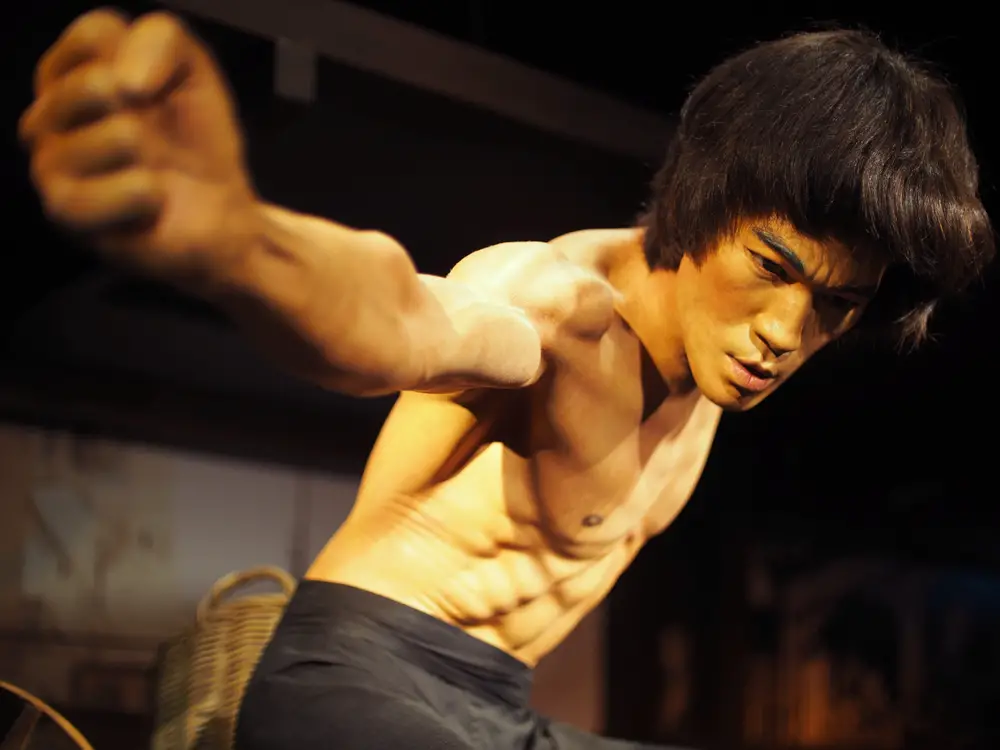
Bruce Lee was 32 years old, in the best shape of his life, and weeks away from becoming the biggest movie star on the planet. Then he took a nap and never woke up. That was July 20, 1973. More than fifty years later, we still don’t have a straight answer about what killed him — and the official explanation has been falling apart almost since the day it was given.
What we do know is that the details of that day are strange, the cover-up was immediate, and at least four different medical theories have been floated over the decades. None of them fully stick. Here’s why.
He Didn’t Die Where They Said He Did
The very first thing Bruce Lee’s inner circle did after he died was lie about where it happened. Producer Raymond Chow initially told the press and police that Lee had died at home. He hadn’t. He died in the apartment of Betty Ting Pei, a Taiwanese actress widely believed to be Lee’s mistress. Her apartment was at 67 Beacon Hill Road in Kowloon Tong, Hong Kong. Lee’s actual home was at 41 Cumberland Road — a completely different address.
The lie lasted about two days. An intrepid reporter named H.S. Chow from The China Mail tracked down the ambulance log, found the driver, and got him to talk. Ambulance #40 had picked up Bruce Lee from a second-floor apartment at Beacon Hill Road, not Cumberland. The story collapsed, and suddenly the most famous death in Hong Kong had a scandal attached to it.
Betty Ting Pei was 26 at the time. She didn’t speak publicly in detail about that night for decades. When she finally did — in a 2025 TVB documentary — she said Raymond Chow had told her to wait for him before calling emergency services. She admitted she panicked and didn’t know what to do. “The man adored by millions died in my bed,” she said. “I became the enemy of the public.”
The Official Cause of Death Has a Big Problem
The coroner’s report ruled Lee’s death a “misadventure” — not an accident, but a death caused by a dangerous, voluntary risk. The specific cause was listed as cerebral edema brought on by a hypersensitive reaction to Equagesic, a painkiller containing aspirin and a tranquilizer called meprobamate. Case closed, right?
Except Lee had taken Equagesic before with no reaction. His family had taken it. Betty Ting Pei’s family had taken it. It was a common over-the-counter-level painkiller at the time. And here’s the thing that really matters: Lee took the pill after he already felt sick. He was complaining of a headache and dizziness around 7:30 p.m. — before he ever swallowed anything. If the drug caused the brain swelling, why was he already showing symptoms of brain swelling before he took it?
On top of that, if it had been a true allergic reaction — anaphylaxis — the autopsy should have shown an inflamed trachea, swollen tongue and lips, hives, and red itchy skin. It showed none of that. Zero. The autopsy showed one dramatic finding: Lee’s brain weighed 1,575 grams. A normal brain weighs about 1,400 grams. That’s a 12.5% increase. His brain was waterlogged, and nobody could explain why.
He Had a Warning Two Months Earlier That Everyone Ignored
On May 10, 1973 — just 71 days before he died — Lee collapsed during a voiceover session for Enter the Dragon at Golden Harvest studios in Hong Kong. He wasn’t just tired. He was having epileptic seizures, vomiting, and running a high fever. He was completely unconscious with no signs of breathing. Doctors at Hong Kong Baptist Hospital diagnosed cerebral edema — the same thing that would kill him — and treated it with mannitol to reduce the swelling.
He recovered. He was later flown to UCLA Medical Center, where doctors found he’d had a grand mal seizure and diagnosed him with a convulsive disorder. And then… he went right back to work. He resumed his punishing fitness routine and his strict diet of vegetables, rice, fish, and milk. No baked goods, no refined flour, no sugar. The man was a machine. Or at least he acted like one.
Looking back, that May collapse looks like a dress rehearsal for his death. Same symptoms. Same brain swelling. Same mystery. The only difference is that the first time, someone got to him fast enough.
He Had His Sweat Glands Removed — and It Might Have Mattered
Here’s a detail that barely gets mentioned, but it’s wild. In late 1972, Bruce Lee had his underarm sweat glands surgically removed. The reason? He thought visible armpit sweat looked bad on camera. That’s it. Vanity. And it might have contributed to his death.
Matthew Polly, who wrote the definitive 2018 biography Bruce Lee: A Life, proposed that Lee died from heat stroke made worse by his reduced ability to cool his body. July 20, 1973 was the hottest day of the month in Hong Kong that year. Heat stroke is one of the most common killers of young athletic men — in the U.S. alone, an average of three high school and college football players die from it every summer. A common autopsy finding in heat stroke victims? Cerebral edema.
A person who has suffered one heat stroke is at increased risk for another, and patients can experience organ problems for days and weeks afterward. Sound familiar? May collapse, then July death. Same pattern.
The “Too Much Water” Theory Is the Newest — and the Strangest
In December 2022, a team of kidney researchers published a paper in the Clinical Kidney Journal with a theory that sounds almost like a joke but isn’t. They proposed that Bruce Lee died of hyponatremia — essentially, his blood became too diluted because his kidneys couldn’t get rid of excess water fast enough. When sodium levels in your blood drop too low, water floods into your brain cells. They swell. You get cerebral edema. You die.
The researchers listed all of Lee’s risk factors: high chronic fluid intake, marijuana use (which increases thirst), prescription drugs including diuretics and NSAIDs, alcohol, low solute intake from his restrictive diet, and heavy exercise. All of these mess with your body’s ability to regulate water. Stack them all together and you’ve got a recipe for disaster.
The researchers ended their paper with a grim twist on Lee’s most famous quote: “Be water, my friend. But not too much water.” Hyponatremia shows up in about 40% of hospitalized patients and can kill even young, healthy people if they drink way too much water in a short period — something that’s happened in fraternity hazing incidents and radio station contests right here in the U.S.
The Drug Letters Nobody Knew About Until 2021
In July 2021, a private collection of more than 40 handwritten letters from Bruce Lee to fellow actor Robert “Bob” Baker sold at Heritage Auctions for $462,500. These letters, written between 1967 and 1973, included requests by Lee for Baker to mail him cocaine, painkillers, psilocybin, and other drugs for personal use.
This shattered the public image of Lee as a clean-living fitness purist. Sure, he avoided refined sugar and flour. He drank blended raw hamburger meat for protein. But he was also using hard drugs and psychedelics. A Hong Kong physician, Dr. Poon Wai-ming, suggested that cocaine use could have caused his May 1973 collapse — the one everyone assumed was just overwork.
On the day he died, Lee had consumed marijuana — traces were found in his stomach at autopsy. He had hash earlier that afternoon with a colleague named Andre Morgan. Cannabis intoxication was briefly floated as a cause of death, though there’s no established medical link between marijuana and brain swelling.
Fifty Years of Theories and Still No Clear Answer
So what actually killed Bruce Lee? Was it an allergic reaction to a painkiller he’d taken before without problems? Heat stroke made worse by surgically removed sweat glands? Water poisoning from chronically overloaded kidneys? Cocaine damage from years of secret drug use? Or sudden unexpected death from epilepsy, as a 2025 Hong Kong documentary concluded?
Pick your theory. Every few years, someone comes along with a new one. The conspiracy theories — poisoned by Japanese ninjas, killed by an ancient curse, bad feng shui — are easy to laugh off. But the medical theories keep multiplying because the evidence genuinely doesn’t point to one clean answer.
What’s clear is that the people closest to Lee scrambled to control the story from the first hour. They moved the narrative away from Betty Ting Pei’s apartment. They downplayed the drug use. They accepted a cause of death that didn’t match the autopsy findings. And by the time anyone thought to push back, Bruce Lee was already buried — first in Hong Kong in a bronze casket, then permanently in Seattle’s Lake View Cemetery, 7,000 miles from where he fell asleep for the last time in a one-bedroom apartment that wasn’t his.
His son Brandon Lee would die twenty years later, at age 28, from a bizarre on-set accident while filming The Crow. Two deaths, both young, both strange, both surrounded by questions. The Lee family, it seems, was never allowed a simple ending.

